How nice to be able to record the state of Helen's garden, now become an engine in its own life.
The past year was tough with months of drought but spring and now summer have brought good rain. We have developed a pattern in the past month of spending Friday evening and Saturday morning here. My physical limitations significant but able to use iPad for some photos. Also able to manage the battery powered Stihl chainsaw bought for Helen's birthday.
Here are some photos. One of the developments of the past year has been the completion of a retail building across the street, that robs not just parking but also the view of the ranges. You will see that Helen's establishment of a front hedge preserves some privacy.
So the view from the bedroom at 6.30am now includes cars and building but less of the distant view.
In the foreground, the beginning of training a quince into a circle.
These next show how the front garden becomes a food forest, and also shows the industrious gardener.
The wild fennel is valuable in the kitchen. The woody stalks are valuable as mulch.
constant mulching and cutting dumping in gardens in the backyard yields soil eventually, Quality soil. Here transferred to a garden in the front to cover roots recently exposed by heavy rain.
Because this was then mulched well, a storm (65mm) in the afternoon did not wash soil away.
This hedge produces red flowers.
...shaped a week ago with electric hedge trimmer, already doing its best to look ragged.
a peak into a citrus forest
This began with two strands tied together, much as that quince above
Yes, mosaics on steps
The shade cloth has been adjusted since this photo.
The plants underneath growing quickly. Rosellas — the plants not the birds.
Yes, a bay and and an olive tree and a feijoa bush visible beyond. The rubber tree centre left will have its top taken off, the bare trunk will provide a place to host a micro-bat home (I can't make them for this price for two).The rosella hedge will not be high, I said.
No, she said, there will be citrus trees in the mulch behind.
Aha, the permaculture principle of yield per square metre rather than yield per plant.
And with that she went to say good morning to Cory Gated, the giraffe.
Loganberries are difficult here. In hot days the fruit boils, but if you can catch them at the right moment...
This is hedge to the right of the car above. Drive-in picking.
A view of the back back yard, featuring a wattle, see movie.
For Helen's birthday, for Helen's garden, a new Stihl MSA 120C, battery powered chainsaw. I can do this work, though briefly. No need to be more than briefly when it's easy to use, clean and you don't have to mess about with mixing fuel and only using fresh fuel...
I'd not used a chainsaw for a year. So failed to anticipate that torsion in the weight of first couple of limbs of this wattle would jam to the chain so easily. Lots of rain, heavy limbs.
We will not remove much more of this wattle, it serves a great purpose in the garden, generally not understood. Acacias are pioneers, they grow swiftly. Like legumes they have nitrogen fixing nodules on their roots. But unlike legumes, which lower pH, these acacias raise pH, valuable in most Australian soils. The tree recovers from hard pruning well. Every time you prune the top, a comparable amount of root dies, releasing carbon and nitrogen. And as the roots grow, they mine the soil, open it up for less vigorous plants. A multifunction plant.
This light chainsaw makes light work. To have an arborist in would mean having the whole tree whacked and a huge mess of the valuable pruned material gone. But with the saw on hand, easy to prune part of it at a time and review.
At the end of the movie see why it was good to prune early morning, see the 1pm storm.
With the circular device on the left, easy to adjust the chain. And the instruction book is very clear.
To clean, I used kitchen paper and a basting brush...
I'll get a small round bristle paint brush, which will clean the screw holes better.
My chain saw rules remain:
clean wood, sharp chain
right fuel mixed (now well charged battery)
Only when weather is right and ground is clear.
Only when feeling very well.
Only one tank, or less...
... replaced by 'only one battery charge'.
And now no need to deal with leftover fuel mix, going stale.
Wattles, next generation
These require boiling water or scratching to open them to germinate.
In nature, in Australia, many seeds like this await bushfire to open their pod or shell,
to grow in the wealth of the ashes on soil (raised pH, carbon and potassium).
This view back towards that wattle: from left, banana, tap/sink with mosaic, lemongrass, very productive custarnd apple hiding nashi tree, wild fennel and on the right pomegranate hidden by comfrey and sulking. Everything likes to pop up from the mulch under the clothes line.
Farm people, as seen from laundry door facing clothes line.
Rosemary, lemongrass, custard apple ... and Ralph.
While waiting at the bus stop in Ladispoli, to go to Cerveteri, in 2011
Helen fell in love with lions on the house opposite.
I found these two lions through ebay, made by backyard hobbyist in Sydney.
Flowers on the custard apple.
For your imagination! You can't see that the green tank collects water from the invisible house roof, connected also to another tank doing the same behind the camera. Nor can you see the pump that is inside that tank down there, that pumps to a tank up the hill, out of sight, at the back fence, with pipes then to gravity feed to taps in front and back garden.
These two photos show the mass of fallen material from wattle (which I had chopped up variously, some longer pieces for edging here and there, finer material for mulch. The second photo shows that most of it did not have to be moved far. The large leafed tree is a guava.
it's not a python, it's the scarf I took off before using the chain saw.
Down the end here, in front of shed, rosemary hedge converted to a rosemary tree, making space for a seedling passionfruit.
Blue space, Corina's spade, with spoodle, mosaics, bananas, fine legs, gardener eating.
Down the end, tamarillos, still struggling from decision to plant them on south side of fence.
I brought a kitchen knife to remove most of the bananas as should after fruiting.
"No don't reduce it to two, they shade the pool.
I've just filled the pool and it's a hiding place for the big lizards."
Near 9am, time for me to make coffee!
I do not stink of chainsaw fuel and I do not have to change clothes.
I realise it's been half a year since last entry in this blog.
The climate has been rough, as also for many others in other places.
The sharp changes in weather, plus strong spring winds, meant a lack of bees and pollenation in Dennis's garden, notably for the tamarillos for which we had great expectations, but negligible fruit set. We enjoyed bananas: in this cooler climate the lady fingers ripen very slowly and though skin showing experience of winter and wind, the fruit itself rich as custard. Would that they did not all ripen at once. Now we have new banana bunches and growing guava fruit. A tropical tendency.
In Dennis's garden the soil historically shallow and on top of very deep fast draining sandstone, so moisture retention is difficult and compost and mulch tasks constant. With an eye to whether to let the more sensitive go, and accept shift to a more desert-like environment, grabbing niche moments and using microclimate corners for growing leafy greens. Visually it's currently full of gone-to-seed fennel (we've abandoned use of onions in cooking, fennel a wonderful replacement) and herbs that think they are in the heaven of a hot Greek plain, but without the goats.
In Helen's garden, a different situation: milder and more humid, 30km away, by the sea. Volcanic soil, good water retention, very pleased with custard apples and more. Now near forty fruit trees... and some small bleeding heart trees, seedlings which began in my raised strawberry bed, above which bower or black birds sat strawberry-oggline, before dropping a fertilised seed. Now doing well in understorey environment which they need most.
We are planning micro-bee habitats for Dennis's garden for pollenation; micro-bat housing for Helen's garden, where there is a bit of a mosquito problem.
Photos from Helen's garden 15 February 2018: (click on any photo to enlarge all)
outside the kitchen
up steps from previous photo
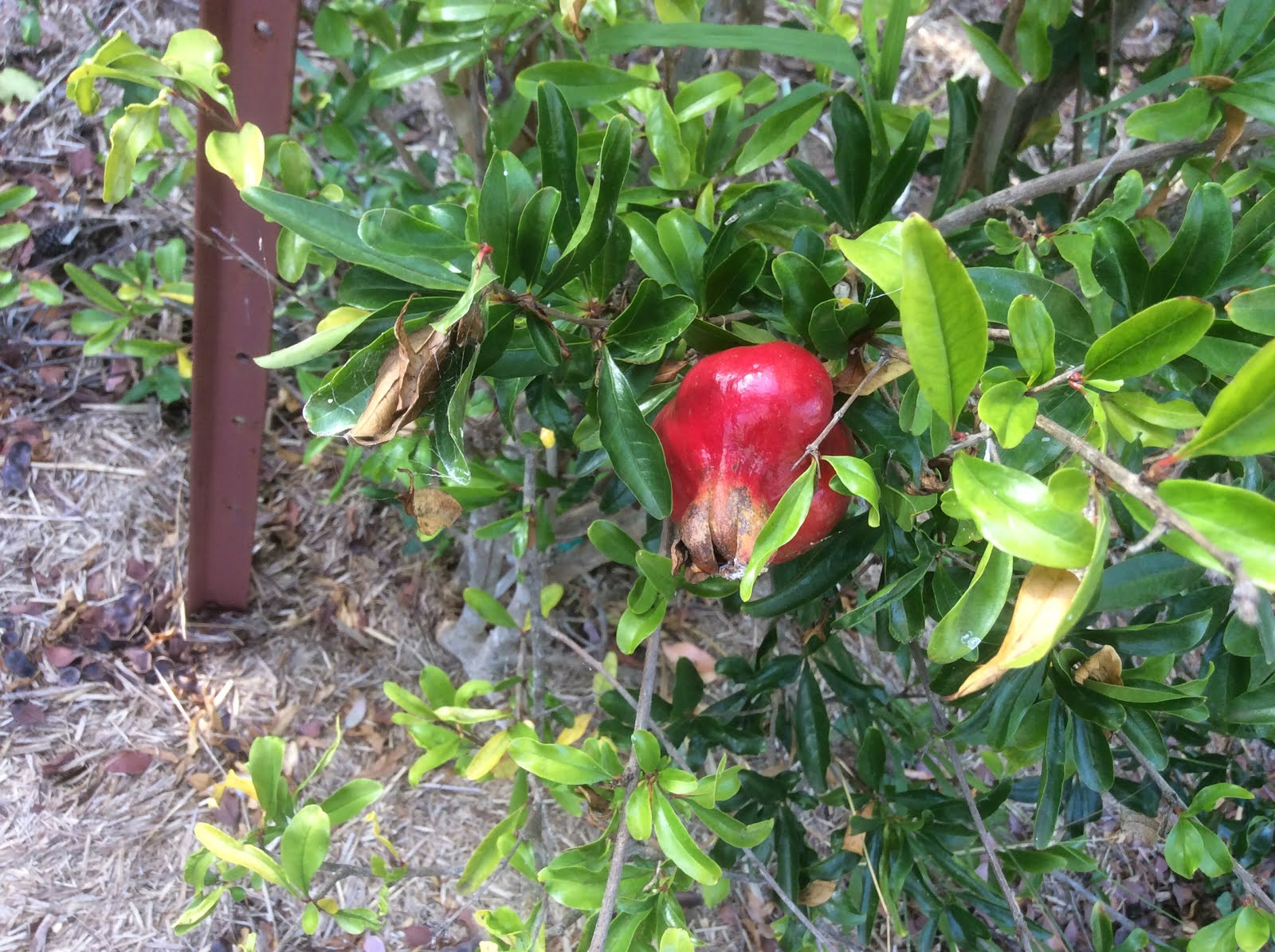
up close in that backyard view, a pomegranate at last
in front of the house
view from street, morning sunlight
Lemon tree view through hole in hedge (which you probably can't see in last pic)
Fennel with spider web
-------
AS mentioned above we are making habitat for micro-bees and micro-bats.
And here is a man in the UK wonderfully obsessed with micro-bee habitat construction and so much more... so many ideas! If in a rush, skip the first eight minutes of this...
Here's a thoughtful, concept focused, presentation about micro-bats
Team work here is fun but design may not be ideal
— could be taller, can't see if internal surfaces are rough enough (decking is good),
and colour depends on climate: bats need to be above human blood temperature for comfort)
Down there in the out of focus short distance, the hen house.
Here for my Sunday lunch, three eggs fetched this morning from the hens not long before their conversion into light scrambled-omelet with fresh garden herbs and rocket (arugola) too. Helen out to lunch with her sister, a Sunday sororal pattern.
Thus I have another chance of a moment or 20 in this magic garden. During the week I had cause to write somewhere else about last Sunday at this table and how
as I sat in dreamy
sunlight at a small mosaic table in my garden, eating crumbed fish on a plate with knife and fork, a tiny beautiful wasp-waisted paper wasp alighted on the other edge of
the table, opposite me, almost missing the table edge in its sensory stupefaction,
straightened itself, waggled its antennae to clarify and reconfirm the fishness
that brought it thus far, then set out, straight line, gentle march, across the
table towards me.
I ended that piece of writing with such suspense. I can report (alas no camera) that the small drop-dead-gorgeous wasp did continue forward and did disappear under the edge of my plate. I waited silently to see if it could find its way to the top of the plate (as a fly or cockroach might, if permitted) but no, eventually it wandered disconsolately away slowly towards my 2 o'clock. I picked a tiny crumb from my plate and dropped it at 10 o'clock but the act of doing so broke the spell and the wasp wimped and flew instantly off.
I am reminded writing this and recalling these instances of beauty of Masanobu Fukuoka's observation in One Straw Revolution, in the box on the left.
Fukuoka has been a great influence on me. I agree with the virtue of that quote more than anything as a jolt for the mind, a what-the-hell-is-he-getting-at.
The purpose of the old mosaic table being – this week and last, everything changes – to meet the wasp and show respect for the hens and the eggs. AND for the sunlight in cool late winter. Looking at bare things around me, trying to be here and now, not just planning the look and yields of summer. Mindful.
The two hens are doing well, though perverse dark weather stopped egg laying early and they are just resuming now.
We moved their house, in fact have set up two houses, so they can readily be moved to clean ground and where they have been can be put to crops for them or for us.
Because of previous problems with pigeons, sparrows and others spending a lot of time in the chook pen, eating food and creating potential for disease transfer, we have netted over small runs.
Enclosing the whole run under net means we can broadcast seed without the whole neighbourhood reporting for eats.
The hens tend to go for the better, higher protein seeds, leaving the wheat.
With their 'scratch mix' spread on the ground, if the ground is wet by rain or human intervention,
wheat seeds scratched into the ground will sprout. At which time we can ease up on fresh feed until they have eaten the sprouts... wheat probably more nutritious and digestible as sprouts.
The provision of water is important. Rather than provide some plastic container, etc, we have a pond which runs from inside to outside the chook run. On the outside, plants, insects, frog, etc, which could not survive on the inside.
This chook run is squeezed in adjacent to mini-rainforest with torii
And at another part of the garden, a new chook run awaits. With the netting over it, down the end there, we now have broadcast scratch mix (mixed seed) and covered it with straw mulch and kept watering. So that we now have a mini-pasture sprouting. This heals the soil and provides a nutritional start when the chooks arrive. More detail later.
this photo takes us into the kitchen mantra, regarding waste minimising: dog, chook, compost, garbage
But as seems to happen often the bower and Odimbar its boss are gone. Perhaps standard rivalry, perhaps also finally finally as temperatures fell and the autumn lovely weather yielded to far-to-early winds of September, come fresh-chilled from the highlands, Odimbar may have just said "this is ridiculous!" But as per regular, the bower is smashed into the ground and other birds have stolen his blue treasures.
I have left that camera there and will check it so we can see the random mooching of winter and the beginning of rites of spring, should this shady nook be again favoured with bowerbird presence.
------------------
Meanwhile this morning after 8am I have been out and done a quick inventory.
At the front door the ladies are still in charge, though one seems (perhaps consequence of being inadequately dressed, pretty baubles hardly suffice) to have caught cold and the other seems to be concerned about the pig getting away.
With Renay the gardener I have done a lot of winter trimming, the garden looks hard cut in places but it will riot in spring. We have water, are proofed against an alarming sudden drought, total dryness on southeastern Australia this past month, El Niño back with a vengeance.
From the kitchen, looking towards the rising sun, the view is industrial
the necessity of netting against birds, blackbirds, bowerbirds and parrots
The garden is crowded, it's an interesting walk but difficult to photograph (at least for me).
A surprise in the heat of the summer was the appearance of a pawpaw (or papaya) from a hole near the bottom of the black compost bin. We first expanded the hole and subsequently took the bin away, covered the compost with black plastic and left the pawpaw to grow. Over 2 metres in five months. And with several flowers last week. But a frost two nights ago. Which has killed most leaves, new leaves seem to be surviving. If it gets through the cold and wind of this winter it should be tall enough next year. The compost heap under black plastic provides some soil warmth.
Older outer leaves of the pawpaw stung by frost morning of 22 July.
Young leave so far OK. You can see how slender, fast-grown, vulnerable.
The pawpaw lurks behind a Gymea Lily.
The Gymea Lily was a 15cm high gift in 2008 when the garden was a desert. It is now just a bunch of pointies almost 2 metres high. It illustrates the way gardens grow and change. There should be no notion of a static garden.
Plainly the garden is going to have to make adjustments as the Gymea lily grows.
As the map shows, this plant has a very limited range. Near here it makes, with its very tall flowers, an unusual planting for the middle of the highway.
In this photo below, looking into the morning sunlight, see the black plastic, held down by white concrete breeze blocks, at the foot of the pawpaw. The Gymea Lily alongside. The fig tree has been pruned very hard, it grows back vigorously.
This next picture shows the 'floor' of the cafe mulched in part with purchased eucalyptus chip (dark colour) and partly with chipped fig, wattle and mandarin (the light and dark chips).
There is also a view of my (so far successful) efforts to 'graft' a Hardenbergia violacea onto the stump of a Bangalow Palm. We have two such palms thriving, the third caused too much shade. Again this is something that is decided as the garden evolves. See the (marginally) elegant fleur de lis climbing pole for this handsome native legume. See also lurking a piece of 3/4" polypipe stuck deep in the soil to provide water down low in the root zone, to draw the roots swiftly to the ground. Nitrogen-fixing plants (legumes and acacias) to be put in everywhere possible.
In the rear of the photo in front of the lattice is a wattle. This has been savagely pruned every year, multiple times. It survives. Wattles (Australia's plant emblem) are acacias, like legumes they have bacterial nodules on their roots which 'fix' nitrogen from the air, making it available to plant roots. They differ from legumes in that legumes tend to lower soil pH whereas acacia raise pH, valuable in Australia where most soils are ancient, or overworked, and acid. This savagely treated wattle, when pruned, also suffers death to roots, which makes both carbon and nitrogen available to the soil along with the humic virtues of decomposition. Its roots grow as fast as its branches – it is a deep plough. Its pruned branches, put through the mulcher or used in hugel beds, are quick rotting and nitrogenous.
The netting covers newly-planted lettuce, also bean and pea seeds in there to grow on the frame supporting the net.
In the next photo below you can see, as Ralph and the bear can see, the lattice no longer has clothes. There was hitherto a 20 metre spread of a single passionfruit plant dense heavy foliage, as also there was a home for chooks (chickens) right there below the bear. We have moved the hens to a fresh location (good for them, good for the soil) also clearing space for fence repair/replacement. Passionfruit plants must be replaced every three or four years. This is another evolving thing in the garden – where to start a new passionfruit vine when the current one is thriving... Meanwhile we have more sun and fresh perspectives. And a cafe space.
You can see (below) the black compost bin in a new location. We are adopting a new practice, Renay's practice, of not emptying the bin but moving the structure to a new location, leaving compost in place (covered with black plastic while breakdown is finished). You can see a green wire device hanging to the left of the compost. This has a corkscrew end. It is very valuable for aerating the compost, preventing lower levels from becoming anaerobic. A good aerobic compost (with air access) smells sweet. Anaerobic (no air access) compost has a smell, well, we all produce anaerobic substances from our guts. Sun on the black plastic is important. Unpleasant bacteria (and weed seeds) will be killed if the contents of the bin get to more than about 50 degrees celsius. You can see some remnants of passionfruit in the mesh beside the bear. The bear is looking down upon a miniature Eureka Lemon newly planted and tip pruned to encourage growth. The lemon is planted into the top of a hugel bed which contains logs of wattle, vine of passionfruit, bags of horse manure and stable mulch, several buckets of soil, plus additives. In making a mound like this, it is important to water everything in well, eliminating air gaps. The bed will collapse to near ground level through next summer, converting to good humus. The lemon will be espaliered along the mesh. The mesh runs east-west. The other side of the tree is north facing (sun-facing here in the southern temperate zone). Eureka the lemon of choice because it produces fruit for almost the whole year. The location is 15 seconds from the kitchen.. design, design, design :-)
• volcanic rock dust. We are here on worn out thin old dairy farm soil, sitting on hundreds of feet of sandstone and conglomerate. The volcanic rock dust does not give us volcanic soil but provides many nutrients found in volcanic soils.
I wrote just there 'not very balanced'. The greatest balancing of soil is achieved by composting processes and the development of humus. That is the basic objective in this hugel bed. A slow composting, not hot and fast.
We occupy a suburban lot, of a size conventional around here in about 1990. In the satellite view, we are seen to have more tree cover than most neighbours. We have the red roof, with solar panels. The massive tree in the garden to the north is a eucalypt, remorselessly growing and increasingly over shading our back garden in winter when the sun angles in from the north (we are in the southern hemisphere). An issue in this country is vulnerability to fire in areas of bushland. Fire is an especially serious risk in forests with high oil content, such as our eucalypt forests or pine forests in California. Our suburban food forest is of trees more likely to be fire retardand.
Just outside the white roof coloured back veranda space is a shock of green colour. A couple of years ago I had planted a reluctant seedling passionfruit, something that emerged from a friend's compost. Then I moved the chicken run, just two hens, to that area.
The single passionfruit vine, visible from outer space, the big green blob, overshadows much of the chook run, providing hundred of fruit per year. But these vines only live a few years. So the most important important thing in a food-productive garden is the planning of succession. What to grow for how long, what to succeed what? When to plant new passionfruit, to ensure that when one dies, others will be near fruiting maturity. How to allow for the fact that not all things planted, not all thrive... and at the other end of the spectrum, the problem that the very very happy plant may not feel the urge to reproduce, to produce fruit and seeds. In ortobiologicale vernacular Italian, such a plant may be called a vagabondo and a farmer might bash the tree with a hammer to scare it into reproduction.
screenshot from wikipedia
In a modern office, serious people might draw Gantt charts to decide what needs to be done in what order. In my permaculture garden, there is more the task of saying "where the hell is there some space for this?" but with an eye for sun and shadow, for neighbouring plants and the way they will grow.
I recently planted in the backyard a yellow guava, a nashi pear and a tamarillo near each other. In a suntrap. Adjacent to a non-fruitful peach that in summer is allowed to protect a north facing window. The tamarillo is very close to the guava, but will race past it, overshadow it, for several years, and then die. The guava can be pruned to something of a delicious hedge beside a path. The nashi - a nijisseiki, or Twentieth Century Nashi - is a dwarf tree, fruit will remain within hand reach and will be relatively easy to check for pests. There is long historical agreement that the footsteps or the shadow of the farmer is the best fertiliser.
That long prologue is a way into saying that an inventory of a garden is an inventory of the impermanent, of the constant changing, the hugely pleasant place of surprises. And an inventory of the food productive plants in the garden is a terribly diminished perspective in a garden filled with other plants which are there for the eye and the spirit and the birds and bees, without which no fruit. And much less pleasure.
Anyway, let's get to lists
Front garden, intense sun, high winds at times, history as clapped out dairy pasture, weak soil on hard pan caused probably by superphosphate use and heavy bovine traffic, underlain by hundreds of feet of fast draining sandstone and conglomerate. I add volcanic rock dust, manures, compost teas, compost, mulch and trace elements and with old pvc or terracotta pipe lengths do much of the watering direct to a foot or more underground, with some of the manure and rock dust in the pipe for solution.
Guava, small red intense fruit, one mature, two immature.
Pear, Ya, dwarf - a Chinese variety for pollination of the Nashi in the backyard.
Jaboticaba, two, aged 8, still very small. Perhaps too far from the Amazon...
White Sapote, tall, eight years old, still fruitless
Oranges, large valencia and navel, heavy bearing, currently covered in blossom.
Tahitian lime x2. Young, but have already produced fruit and second season fruit set has taken place.
Bananas, two stands, different varieties. Currently leaves shredded by spring winds. Neither fruited yet. In this front garden it is taking time to get soils rich and with very porous rock under, hard to keep moisture in the root zone. These are thirsty heavy feeders. But they look good!
Cape Gooseberry, several plants, young
Pepinos, now fruiting heavily.
Pitanga, very small, unkillable. A gift I have tried to allow to die but which won't die. This must be why it's regarded as a pest here.
Namoi Woolly Pod Vetch, twining everywhere as ground cover, easily snatched and grazed by hand for use immediately as high nitrogen mulch around trees or given to chooks.
Back garden, more inspected and worked than front garden, some valuable heat trap areas. Soil improves faster. Hens on a length of the boundary, reducing snail and other unwanted presences. Some areas more shaded for part of the day.
Layering, see pepinos.
This is a classy cute
style of doing it, from wikipedia.
I just drop an old brick
on part of the plant near the ground
and leave for a month or three.
Espaliered Lisbon lemon.
Passionfruit gone mad, roots under hens.
chives, nasturtiums, marjoram, eggs, mints, Greek celery, yarrow, fennel, rocket, bay, spring onions, spinach, garlic.
Fig, vigorous, fruitful, hard pruned.
Custard apple, totters through winter.
Bananas two stands. Fruitful: flowers appear in heat of summer, fruit may take a year to ripen into short ladyfinger type bananas, with intense flavour.
strawberries
Asparagus which seem to be eaten by hens at the moment.
Rhubarb, vigorous, need good feeding. The dark colour when temperature under about 25 degrees, summer crops may be insipid, but they are grown on east side of house, scant afternoon light.