Thursday, April 14, 2016

long after summer

The last post here in August, now April.

An exceptionally hot and challenging summer for the garden, with breaks of cold and wet then rushing back into the high 30s (100 Fahrenhiet for the imperial people) to the confusion and upset of human and plant routines. Fruit trees flowering at wrong times, fruit falling off, trees (espceially tamarillos suddenly frying in the heat. Rampant vegetation generally, not least in mini-rainforest.


In such forceful heat, it has been good to have the house now disappearing under green protection.


We may get relatively few conventional eggs from two hens, but the roots of the passionfruit are under the chook run. The passionfruit continues rampant and productive.


 Hens happy


 Other routines maintained, Captain Rattleberry grows into his third year and though desexed he imparts a powerful pheromone to his glamorous cuddle companions, who therefore need a bath too.


The garden is full of birds. I've not been very successful at photographing birds in the garden. With branches closing in on the photographer photos in the garden are becoming generally more difficult. Birds remain hidden in the foliage, wary in this suburban environment.  But on a trip away, in the Blue Mountains last month, I was pleased to get this photo of an Eastern Spinebill, a very common bird here at home.

Eastern Spinebill, Blackheath NSW, March 2016
 First distraction from this blog was action last August-September to prepare wheelchair ramps and paths for a house we had purchased for Helen's sister, 600 metres from my house. With helpers.


Alas all this constructive energy was followed by a mysterious and vicious attack of something called brachial neuritis, the acute phase of which lasted about ten weeks to early February. I continue in the atrophy phase. While it began in my shoulder, it persists especially in my lumbosacral spine and leg. Five months disability is not pleasant at any age, in my 73rd year you get a sense of the clock ticking. I derive some comfort from recognising that most people my age are dead and also noting the diversity of my chronic illnesses -, chronic fatigue, fibromyalgia, etc - and that the really cute thing about chronic illness is that you have to be alive to have one.  :-)

But the photography suffers!

Tuesday, August 11, 2015

Stick weaving in Helen's garden

It's near the end of winter and we pruned and wove the mulberry just in time before new growth. Some inspiration from seeing Patrick Dougherty's work at the Children's Museum in Portland Oregon, but more modest objectives. From this angle you can see the tree is hard pruned and bare, but you can't see the way the tunnel behind the Queen of Liberty (beanie and wool dress for winter) continues to be shaped up.


Photo below: the vertical sticks of mulberry are hard, last year's prunings. They are fixed to the gate by wire. We needed to lift the height of gates and fence in the front yard to contain our precocious promiscuous poodle.
The lateral sticks of mulberry were pruned two days before these photos and Helen has woven them together. They are at this point flexible, will dry hard.


a work in progress


and another work in progress, by Xiao Ran (Mike) the Beijing WWOOFer.


Wednesday, July 22, 2015

Fruity creatures with wet t-shirts.

In last blog entry I set out how we assembled sacks of good soil to grow strawberries hanging from bags. The bags were woven plastic produce bags which would would break up in sunlight.

So for that and aesthetic reasons, I have now dressed these creature in T-shirts. And poured them tea.

And given them old chairs to sit upon, just a little closer to the sun in winter, further from chill ground, snails and rabbits. Easy to check and manage. With 90 or 100mm -> 50mm reducers on the top of centre PVC pipe to increase rain catchment and facilitate watering and adding feeds. Soil made from compost, cocopeat (fine chopped coconut husk), mulched horse manure, volcanic rock dust, plus compost tea (a bin with lid in the garden to which we add water, weeds, manures, volcanic rock dust, seaweed extract, etc.). Some other strawberries in the garden are already flowering. hopefully fruit by November. To add to passionfruit currently cropping heavily.

I added some more plants. I have to say there is a big difference between the sensation of gashing a hole in a produce bag compared with plunging a knife into a well-filled ladies T-shirt and hauling out viscera to make way for an implant. I look over my shoulder for passers-by.

As a system this is easy to replicate. Just adding more chairs. Kind of the way easy for Iran or others to add extra centrifuges to uranium enrichment plants. Kind of.

Or if I can find an old merry-go-round at the recycling I will have a perfect device for getting the sun onto all sides of these bags if I train the poodle to run in circles pulling it. Only needs a lamb chop on a fishing pole in front of him perhaps. But I must remember complex things fail....

I will try hanging them in strong fishing net from tree branches. Where they can spin in the breeze. Without a poodle. Stay tuned.

Here they are. Three bags full:

Click on picture to enlarge. Little sticks in the holes are to discourage the holes from movement.

Thursday, July 9, 2015

strawberries by the bag

http://www.floridavegetablegarden.com/?p=902
I saw this on the web, via pinterest...
and realised it would be a good idea for us.

So with my gardener Renay this morning we made three bags today. We used produce bags, modest size. Even so with damp soil material inside they each way about 25kg (60lbs) at least. So not sure how we will place them in the end. Had had in mind stringing them along a cable, but it will be a heavy load for any cable system.

We are using produce bags which will decompose in sunlight. So after the soil and plants settle, and when they are in eventual place and not going to be moved again, we will put skirts of some fabric around them. We could use hessian but it's very expensive and we can find something bright at a charity shop.

I had learned from the discussion of other people's mistakes and adjustments at link. 
The internet is wonderful when people write openly about their oopses.

So we did this:   [click on any picture to enlarge all)
from experience I knew holes should be small
  1. put about 20cm of cocopeat, expanded in water, in bottom of bag. I put this moisture retaining medium at the bottom of the bag, with no supplements added, so that  [a] the plant roots would in the first instance chase nutrients higher in the bag and [b] as nutrients wash down over time, this cocopeat layer will hold nutrients and not get toxically overloaded.
  2. placed a 50mm pvc pipe in the bag, with cap on bottom, one small hole in bottom three small holes up the pipe. An adaptor from 50mm to 100mm on top to make it easier to add water Tamped the bottom into the peat layer, to make stable.
  3. put had put the leg of an old pair of tracksuit pants around the pipe to slow water travel and prevent blockage of holes by roots. This task seemed to excite Renay.
  4. made a mix of the following: 
    1. cocopeat with water added, also compost tea from our compost tea bin in garden which accepts weeds, manures, volcanic rock dust, etc,
    2. horse manure — which I am able to get from a source where it has been mulched
    3. cow manure — complexity requires
      Easy to cut pvc pipe.
      more stuff
    4. compost from our garden composter

  1. We filled the bag with this mix, tamping down lightly. 
  2. We added some volcanic rock dust at intervals. 
  3. Sewed up the top with baling twine, as comes with the bags of horse manure.
  4. Cut a total of six holes in each bag for strawberry plants. 
  5. Planted the strawberry plants, all of which are runners from our strawberry patches.


The six small cuts for plants were made as follows:the cuts about 4cm + 4cm, slightly upwards to the centre, so when you pull the bag fabric it opens a little lip space and soil does not fall out.
  • three cuts 120 degrees (evenly spaced) around towards the top at the shoulder level of the soil in the bag... the soil may settle, either the plant will grow out happily or we open the bag and add more soil.
  • three cuts a bit further down, same 120 degree interval, offset.
These bags need to settle and the strawberries need to start growing in place now. July here is midwinter, no frost here, but close to freezing at the moment. I have places the bags in a row facing sun in a microclimate location with good sunlight. They are sitting on the ground with a half bag of manure front and back for stability. And a mirror behind to add warmth and light to the back of the bags. As the sun moves, the light shifts from bag to bag and also warms the manure bag.

  Three strawberry vertical garden bags in a row, mirror behind. 

When the soil is settled and roots developed and these are at their final destination, we will find smart tight skirts for these bags, both for aesthetics and also because the bags will disintegrate in sunlight over time. 

In any case, these are things for only one season or so, the soil will, as with soil in pots, need refreshing. 

Not hard to do. As runners develop from these six plants I may make holes for them or begin new bags, we shall see...

Now to find an old bench or such to rest them on, away from ground pests. Here we will also need defences from blackbirds and bowerbirds, for which a number of chopstick sized sticks coming out diagonally at the top with reflective scare tape dangling. Or maybe a net.

Wednesday, July 1, 2015

Mosaics in sand, work of wwoofer Mike

Everyone with a house will have some corner garden, under a roof line, where it is difficult to get anything to grow.

Helen had two next spaces like that. Also Helen was concerned not to have wet garden growth up against the house, encouraging pests including termites.

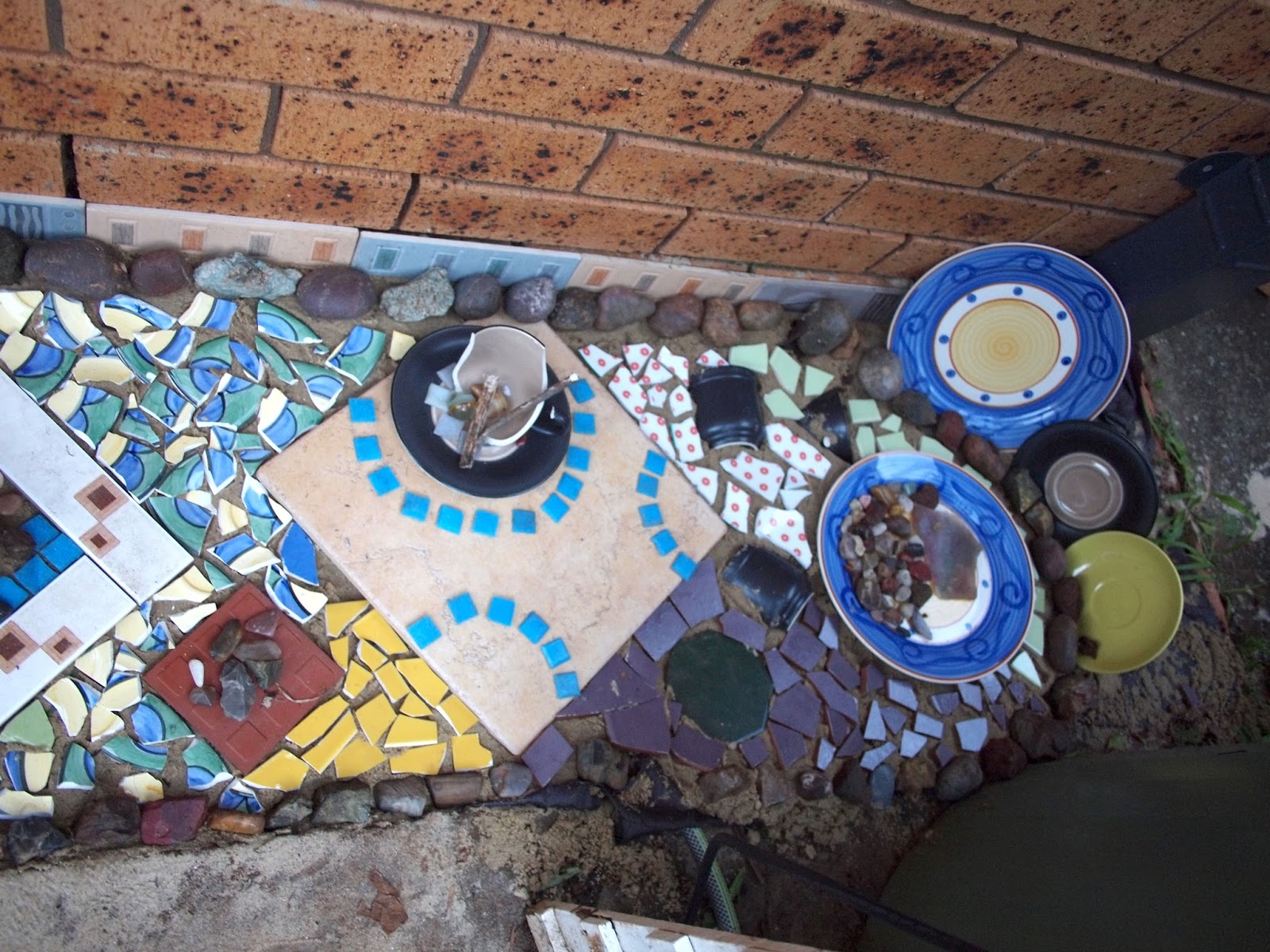
So with a plan, we assembled our collected tiles and broken plates and we entrusted the project to Xiao Ran (Mike), wwoofer from Beijing, after some basic training in mosaic work.

We knew Mike was clever, we knew he had never done a project like this before. The results are wonderful.

Mosaic work is interesting because it allows you to play with shapes and forms. It allows you to smash plates. You shift into a creative mind-space. As design develops, you begin to see more and more what is possible. And Mike's creative mind ran and ran. Imagination! Discipline. Hard work too. Place pieces, step back, look, have a coffee, look again, pick up most of it, rearrange, and then again...

This work is not concreted in. Earth and weeds were removed to a depth of about 75mm (3in), cloth put down flat on the ground as a weed barrier, then sand... and the mosaic pieces laid on top. Rain will alter this, as will wind, birds and lizards. Really part of the garden, subject to change.

Thanks Mike! 

click on any photo to enlarge all


 We used a lot of tiles but we still have some more.


in the middle, a few harvested passionfruit and macadamia nuts. 

Photography offers some opportunities like mosaic work, assembling forms.


Friday, June 19, 2015

In the USA and Mexico

Berkeley sculpture garden
I was blogging in May and June in north America, two blogs whose titles are self-explanatory:

http://seattletosanfrancisco2015.blogspot.com.au/
and
http://ongoingtomexico.blogspot.com.au/

There is more of garden relevance and much inspiration for us recorded in the USA blog and this link will take you to blog entries that I tagged with the label 'garden'.

In Seattle, San Francisco and Berkeley we saw a lot of footpath gardens. In Berkeley a very special sculpture garden. Examples of these at link.

Only in San Francisco did we meet a pig on a leash.

These following two pictures in 82nd St, Greenwood, Seattle, mid-May 2015.


Monday, April 13, 2015

Meanwhile, at Helen's house

Although Helen's soil is volcanic in origin, Helen has installed two 'WormFeast' mini-and-underground composters, as described in yesterday's post. Whether, given the quality of her soil, worms will rush in to the WormFeast or rush out to the garden, we shall see. Certainly in digging to install them there were lots of worms relocated from the soil!

Helen has also built a light frame for a thornless blackberry to climb on, removed from poor performance in a dark location in the back to a brighter location in the front.


The structure being built using hard last-winter prunings from the mulberry also–for the top structure –some long whippy green branches just cut to expose the Queen of Liberty, who remains in glory, flying from the mulberry.


A WormFeast discreetly lurks at one end of a swale above that little garden. Swales are very important on this sloping ground, to catch water and get it underground, not run-off to the street.
There was earlier discussion of swales here.
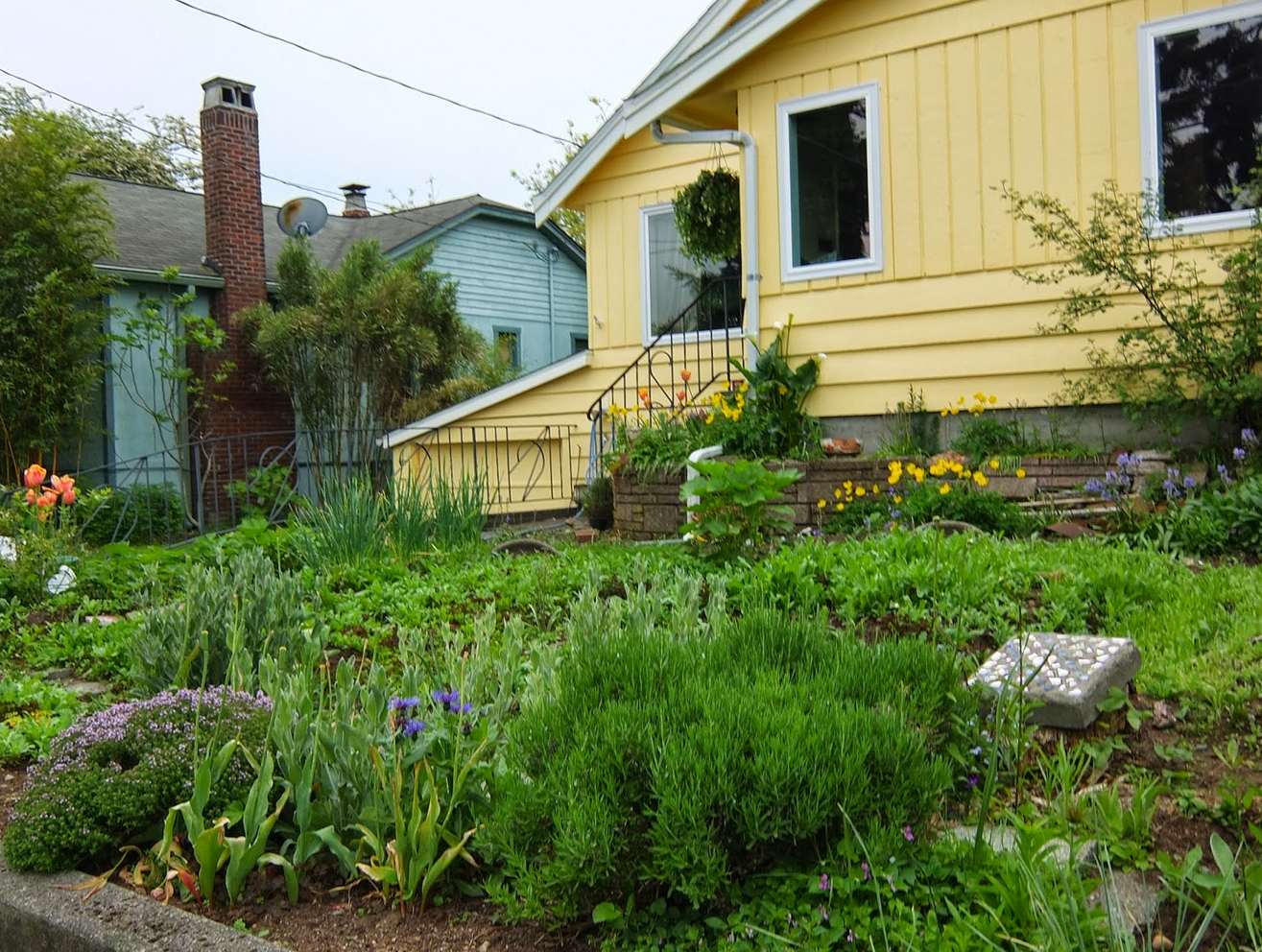

while further up, near the house, the second WormFeast being installed on a slope above a lively garden with apple, citrus and herbs (and of course volunteer tomatoes):


with a live mulch of thyme, dug from where it's running rampant, nearby


Meanwhile in the backyard, the chooks (non-gender generic Australian word for chicken, rooster, hen, etc) are in jungle heaven, having been moved from their well-worn pen at Dennis's house to four months wild growth at their beach jungle at Helen's.

Welcome to the backyard, the passionfruit crop has been big for months.

the three hens came here first when bought at auction end of October 2014. You can see the growth inside the fence and inside their house since they left... in January?

The Livorno (Leghorn) who is the only one laying so far made a huge song and dance setting up her space in the nest box (right hand end of the house) and producing a fine egg straight away. 

These are really creature of the jungle and so happy here in this old vegetable garden run wild. 
Meanwhile I will plant seed in their run at my house to refresh it for their return in some weeks.