Showing posts with label Helen's garden. Show all posts

Thursday, February 15, 2018

and in February (2018)

I realise it's been half a year since last entry in this blog.

The climate has been rough, as also for many others in other places.

The sharp changes in weather, plus strong spring winds, meant a lack of bees and pollenation in Dennis's garden, notably for the tamarillos for which we had great expectations, but negligible fruit set. We enjoyed bananas: in this cooler climate the lady fingers ripen very slowly and though skin showing experience of winter and wind, the fruit itself rich as custard. Would that they did not all ripen at once. Now we have new banana bunches and growing guava fruit. A tropical tendency.

In Dennis's garden the soil historically shallow and on top of very deep fast draining sandstone, so moisture retention is difficult and compost and mulch tasks constant. With an eye to whether to let the more sensitive go, and accept shift to a more desert-like environment, grabbing niche moments and using microclimate corners for growing leafy greens. Visually it's currently full of gone-to-seed fennel (we've abandoned use of onions in cooking, fennel a wonderful replacement) and herbs that think they are in the heaven of a hot Greek plain, but without the goats.

In Helen's garden, a different situation: milder and more humid, 30km away, by the sea. Volcanic soil, good water retention, very pleased with custard apples and more. Now near forty fruit trees... and some small bleeding heart trees, seedlings which began in my raised strawberry bed, above which bower or black birds sat strawberry-oggline, before dropping a fertilised seed. Now doing well in understorey environment which they need most.

We are planning micro-bee habitats for Dennis's garden for pollenation; micro-bat housing for Helen's garden, where there is a bit of a mosquito problem.

Photos from Helen's garden 15 February 2018: (click on any photo to enlarge all)

outside the kitchen

up steps from previous photo

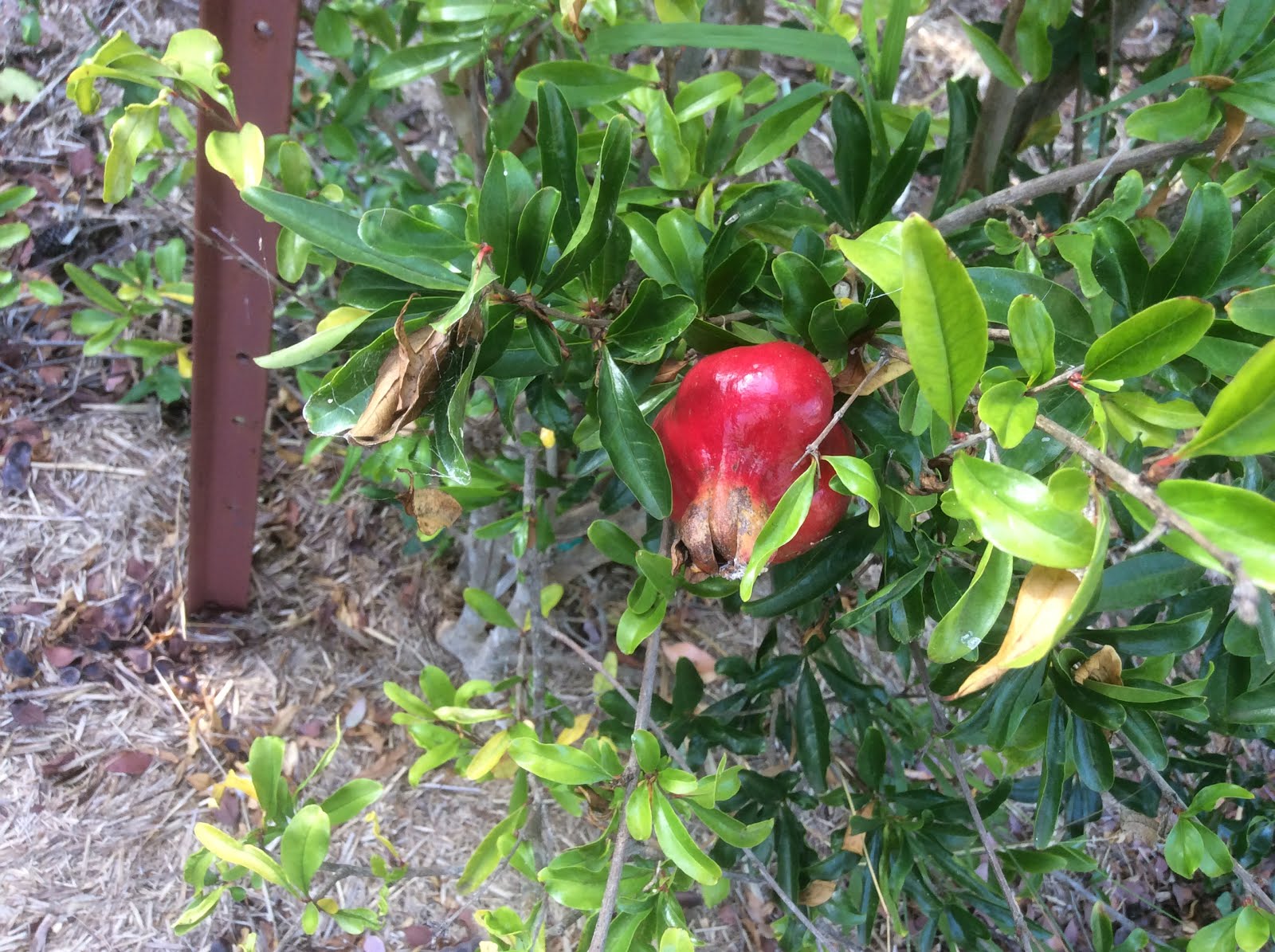
up close in that backyard view, a pomegranate at last


in front of the house
view from street, morning sunlight

Lemon tree view through hole in hedge (which you probably can't see in last pic)

Fennel with spider web

-------

AS mentioned above we are making habitat for micro-bees and micro-bats.

And here is a man in the UK wonderfully obsessed with micro-bee habitat construction and so much more... so many ideas! If in a rush, skip the first eight minutes of this...


and another of his is here

=======

A complete insect hotel from Colorado


 =======

Here's a thoughtful, concept focused, presentation about micro-bats


Team work here is fun but design may not be ideal
— could be taller, can't see if internal surfaces are rough enough (decking is good),
and colour depends on climate: bats need to be above human blood temperature for comfort)


Tuesday, January 7, 2014

Helen's garden, January 2014

 click on any photo to enlarge all

Helen's garden has become luxuriant this summer.
  • In part because the garden reaches towards maturity, more complex, more edge, diverse light and shade.
  • In part because more work, more feed, more water. Water supply assisted by installation of water tanks and pipes and taps to distribute rain water from the roof.
  • In part because more design work, more shaping of the earth with swales, which get water into the ground rather than running away off the sloping block. 
This is an urban engineer's view of swale building. Ours are simpler, simply troughs along a contour, more or less, above a garden or potential garden, to catch water running downhill and put it down where roots can hurry down to find it.

There is one departure from organic principles which will be evident in photos: limited use of glyphosate to control kikuyu at lawn edges. Seven years ago the garden was an even slope entirely covered in kikuyu, which constantly sends runners more than a metre ahead, underground, in seeking to dominate territory. Surface weeding of it of little value, also spreading seed. You will see the grassed area, the kikuyu area, much diminished.

Here are some photos taken on 7 January. Also a couple of photos 15 November with WWOOFer Tatsuyasan, who did lots of work on the swales.

Also, at the end, an accidental movie in the front yard 7 January. Taken ay 8am, this also includes the voices of rainbow laurikeets, feasting on Callistemon [bottle brush] flowers.

Here photos with captions:

This is the view from front steps, away westerly to hills and towards Kangaroo Valley. Callistemon trees with red flowers on left, hear rainbow laurikeets feasting there in movie below.
This is virtually the same photo, exposure to show foreground of garden, shadow line of house roof, sun behind house behind camera, 8am
This from the same step. looking to right. The chip on ground is area of slope levelled three years ago. The mulberry tree throws new branches up two or three metres each year, is pruned and placed in traction to provide increasingly more recreational afternoon shade in this garden area.
This slope beside the front driveway, facing west, has a history of being dry and killing anything planted in it. With great assistance from Tatsuyasan, we built a very simple swale, incorporated peat moss and compost into soil and added lots of seed from old seed packets. Into the swale we chopped nutritious trunks of banana from the backyard.  This photo 15 November, 8 weeks ago.
Approximately same location, see chook, photo 7 January. The sunflower population much increased this year by purchase of 5kg sunflower as bird seed for $8. Many of the plants potentially food productive, many as living or choppable mulch. New growth to citrus not so evident as have been pruned recently.
Actually a view from the backyard down the drive. With that huge passionfruit vine doing well now on north facing fence, it's possible to get out of the car and pick half a dozen passionfruit from the ground any day. Passionfruit are best picked up off the ground daily, rather than picked from vine. Nearer the camera a loganberry grows on the same netting, but is making a slower start, more in shade of house.
A garden is constantly developing. These mosaic steps have been in development for three years now!
In a busy garden there is a constant search for niches. To the right is a swale-aided garden bed, end of cauliflower crop evident, to the left three tamarillo trees, seedlings from Dennis's garden, which will do better when they get out of the shade of the fence. Very resilient and productive in this climate, likely to produce thousands of fruit over a few years of life.
from near point of last photo, looking back to house, via the Queen of Freedom as named by Hong Kong WWOOFer Julie, summer-swimmer clad by Helen, past one of the three paulownia slab gates, timber from former property at Reedy Creek, to work and front veranda.
Potting up these seedling papayas, seed from very tasty fruit eaten several weeks ago. Started in a mix of peat moss and the wonderful compost from zoo near Dennis's place. Note the bush basil seedling which has emerged from a hole at the bottom of the big planter. Wonderful herb which even grows from concrete cracks here, no doubt the seed was in the trough when I put the soil in it. The new pots contain peat moss, wetted and watered afterwards with a watering can soup of a couple of tablespoons of aged, composted horse manure in water, the manure from roadside purchase, left in bag for a long time in the sun, moist with seed hopefully long digested.
Mosaic work on table in shade of mulberry. Note goose in cage, one of the traction devices hung in tree to make branches stoop to provide shade. Helen's turtle mosaics middle of this photo and in last photo, Dennis's on sides in this photo. Every element in a permaculture garden serves multiple functions. The mulberry prunings are great as garden stakes. And–noting again the mosaics and other frivolous elements–it becomes worth doing if you pay attention to the aesthetics of fun.
Before we leave the front garden, tour again in the accidental movie! Click on the arrow doover between HD and vimeo for full screen viewing. Take carsick tablets if necessary  :-)


 ... and now to the luxuriant back garden.

This photo taken by the giraffe (photo above) looking uphill and east.
 The concrete living space behind the house lends itself to pots
... note the water tank down near the lion, some landscape work to come. Two tanks on this wall collect from roof; water pumped to tank at back fence, top of block, from where gravity fed to five outlets front and back yards. Also note the wall of herbs (and bush basil from concrete under table) and strawberries, also the Chinese elm, top right,  planted 1.5 years ago, needing constant shaping, providing increasing protection from harsh sun.
The arch, photo above, supports beans, passionfruit and pumpkin. Some shade and overwatering causing some leaf unhappiness on pumpkin, but if not set back a bit this plant might cover the house by next month!
View above the arch, looking north. As mentioned, some roundup used to control kikuyu. Nice slates from council tip, as also wire and steel supports for beans (and pumpkin)
view from the north. The fancy umbrella busted by Gerringong's notorious winds, function being overtaken by the Chinese elm. Fish cleaning sink in foreground. Back left is a self-sown shrubby wattle, behind the sunflowers. This is about to bloom, after which it will be cut back very hard, to make garden space, also because this is how we manage wattle in the garden. Like legumes, acacias fix atmospheric nitrogen into the soil, but where legumes lower pH, the wattles advantageously raise pH. And the prunings make good nitrogenous mulch, while the reduction of plant mass above ground causes death of comparable root mass below ground, adding to soil carbon and releasing much nitrogen deep in the soil the plant has ploughed.
Backyard swale, his labour produced it, obscured by Tatsuyasan, 15 November last, feeding water runoff to this new garden with some flowering annuals just planted. See wire mesh for beans, behind.
Approximately same location 7 January. Chicory went mad in swale, now about to flower, petunias thrive, lettuce finished; beans climbing, almost to 2 metres behind.
Still waiting for bananas to finish, compare 22 October. Slower ripening provides more taste than most commercial Queensland bananas, provided the season allows the ripening to finish. Well on track to good result this year.
...and finally, where's there's a niche, plant tamarillos en masse. Banana passionfruit to left.
Well, now we have a benchmark for the future. Gardens change, that's much of the fun, excitement from surprises and learning.

Tuesday, October 22, 2013

WWOOFers


We have had two French WWOOFers, David and Nicolas, for a few days.

After a day of mulching and tidying at Dennis's garden, we had a weekend at Helen's garden installing three tall narrow water tanks, two to collect from the roof of the house, the third up the hill - pumping up to it to provide gravity delivery to the whole garden: a kitchen sink in the back garden for cleaning fish, a Porcelaine de Paris basin in the front yard and three ordinary garden taps.

We had a lot of fun. Here we celebrate the work:


In the front garden, the French workers, the French porcelain, the happy clients!

... a little more artistic and structural work to be done! And the tap will be lower!

The proud expert installer!!!


The Adoration of the Banana


The view from the front - highway construction


and we had time to go to the sea, five minutes away


and more fortunate in these days than the people in the Blue Mountains, from where David and Nicolas arrived Thursday.