It's near the end of winter and we pruned and wove the mulberry just in time before new growth. Some inspiration from seeing Patrick Dougherty's work at the Children's Museum in Portland Oregon, but more modest objectives. From this angle you can see the tree is hard pruned and bare, but you can't see the way the tunnel behind the Queen of Liberty (beanie and wool dress for winter) continues to be shaped up.
Photo below: the vertical sticks of mulberry are hard, last year's prunings. They are fixed to the gate by wire. We needed to lift the height of gates and fence in the front yard to contain our precocious promiscuous poodle.
The lateral sticks of mulberry were pruned two days before these photos and Helen has woven them together. They are at this point flexible, will dry hard.
a work in progress
and another work in progress, by Xiao Ran (Mike) the Beijing WWOOFer.
Showing posts with label WWOOF. Show all posts
Tuesday, August 11, 2015
Wednesday, July 1, 2015
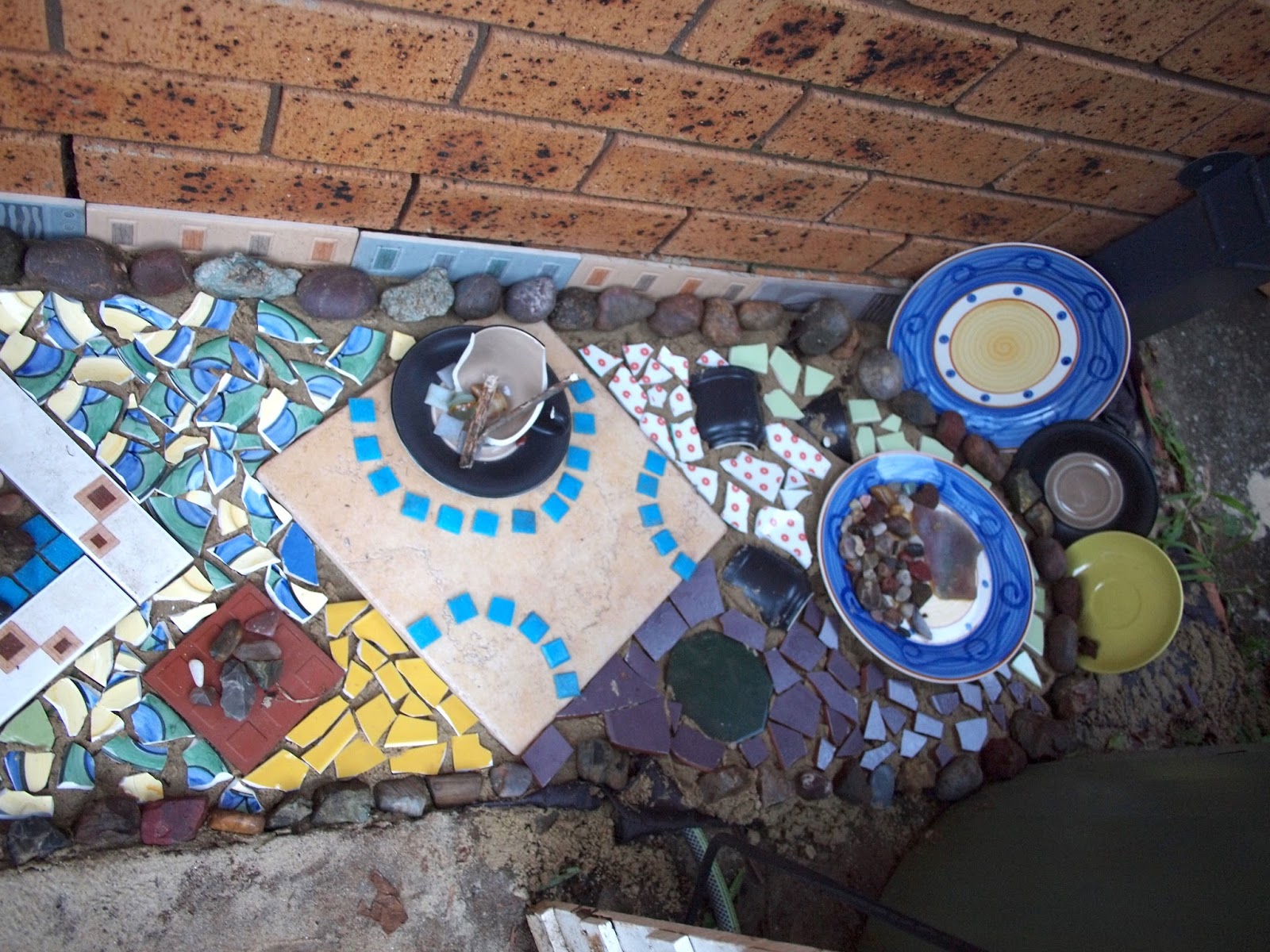
Mosaics in sand, work of wwoofer Mike
Helen had two next spaces like that. Also Helen was concerned not to have wet garden growth up against the house, encouraging pests including termites.
So with a plan, we assembled our collected tiles and broken plates and we entrusted the project to Xiao Ran (Mike), wwoofer from Beijing, after some basic training in mosaic work.
We knew Mike was clever, we knew he had never done a project like this before. The results are wonderful.
Mosaic work is interesting because it allows you to play with shapes and forms. It allows you to smash plates. You shift into a creative mind-space. As design develops, you begin to see more and more what is possible. And Mike's creative mind ran and ran. Imagination! Discipline. Hard work too. Place pieces, step back, look, have a coffee, look again, pick up most of it, rearrange, and then again...
This work is not concreted in. Earth and weeds were removed to a depth of about 75mm (3in), cloth put down flat on the ground as a weed barrier, then sand... and the mosaic pieces laid on top. Rain will alter this, as will wind, birds and lizards. Really part of the garden, subject to change.
Thanks Mike!
click on any photo to enlarge all
We used a lot of tiles but we still have some more.
in the middle, a few harvested passionfruit and macadamia nuts.
Photography offers some opportunities like mosaic work, assembling forms.
Sunday, March 1, 2015
Magic in Helen's garden
We had two house minders to cover absence for five days, they were actually with us almost a month. Kimberly and Jeremie from Montreal became WWOOFers you dream of: excellent company, imaginative, happy at all sorts of work... family.
Jeremie is a landscaper who had done a lot of dry stone wall construction, but had never worked with mortar. He built the required structure. Kim's experience has been as an office administrator. She approached the business of making mosaics with an intense focus on the intricate, a delicate sense of style and ... and a discovered enthusiasm for hitting tiles with a hammer!
They very happily took on a creative project for Helen, to demolish and replace a sink base in the backyard, that which I had constructed in 2013 (with doubts evident from Helen and two French WWOOFers, David and Nicholas in photo below) had succumbed to its own ridiculousness...
![]() |
| The way it was. |
![]() |
| We used some of the demolished blocks, some wood on hand, and some old bricks we had. Dennis did some slave work cleaning bricks. |
![]() |
| Some special items, like this half cup, need placement last, for which a little polyurethane glue is used |
And a week later, some more photos.
![]() |
| Detail of Kim's work. Fine and light... we will have to get the grout right! |
Here's the whole structure again. Thanks Kim and Jeremie!
Wednesday, December 3, 2014
Summer arriving at Helen's garden
Only a few weeks ago, Helen was up in the mulberry, artfully crafting the launch tube for the Queen of Freedom.
but a few weeks later the artful craftiness has been swallowed by spring growth.
There are several lessons and learnings:
- we despair of the mulberry producing good fruit. Despite its label when purchased, it's not really fruitful... but by golly it's brilliant at vegetative growth;
- The pruning of the upperworks needs followup now in summer, when it's not raining, as it is right now, every day;
- Viewed from above, from the front veranda, third photo, you can see that some under-pruning soon will provide a valuable summer shade space.
DETAIL: In the third photo, you will also see a trap to catch Indian Myna birds. The problem is discussed here, in a 2004 report. The problem has grown since then. This YouTube link is to a discussion of how a cage (of slightly different design) works. We have a problem with getting Mynas into this cage. While a lot of mynas come round, especially when there are chickens here and expectation of stealing chicken feed, the dominant bird at Helen's house is the vicious pied currawong. To get Myna birds into the trap we put dried dog food in the entrance. While the currawong is boss of the garden, no one gets to the dog food before the currawong. They have no concern for mynas going for chicken food, the currawongs are meat eaters.
Helen's garden is sloping. The soil is rich dark red, volcanic. This is a contrast to the soil at my place, which is shallow and sits on top of a sandstone plateau, through which water is easily lost... mulch and development of a depth of good humus soil requires work. At Helen's place, this single dig with a fork reveals a very different, richer soil:
Which makes everything flourish.
Helen's garden is packed with plants.
With the addition this morning of two guavas and a kiwiberry, Helen advises that the fairly small garden now contains 31 fruit trees, bushes and vines, plus a macadamia nut which has its first small crop evident now.
For the rest there are many herbs and vegetables, seedling trays and a chook house and run (the beach house of the chooks shown at my place, previous story. They need to come to Helen's soon to give their space at my house a rest.
Help today in planting (and shifting locations of a blood orange and a quince because of their sun needs) from Japanese WWOOFers Kanna and Daisuke, ballet dancer/model and engineering graduate... so well equipped!
![]() |
| Along the street |
![]() |
| We have difficulty getting the thyme and other herbs established in these front steps, because this is west facing and very hot in the afternoon. |
![]() |
| This needs a bit of a trim. Helen has developed a keyhole in this front hedge, through which you can see lemons and a chilli bush. |
![]() |
This garden above, beside the steep driveway, has begun to thrive since, with the help of WWOOFer Tatsuya we built a swale in January.
Water previously just ran away. Now it enters the ground up there below the (grown larger) grapefruit and is retained in the soil below.
The swale is very simple. Most discussion online is about huge swales. But micromanagement of water is very easy.
Rules 1-10:Get the water under the ground! There is no Rule 11.
Here is a photo from January.
![]() |
| healthy cuttings of prostrate thyme, for further reducing grass areas... |
![]() |
| on right, banana passionfruit |
Tuesday, January 7, 2014
Helen's garden, January 2014
click on any photo to enlarge all
Helen's garden has become luxuriant this summer.
- In part because the garden reaches towards maturity, more complex, more edge, diverse light and shade.
- In part because more work, more feed, more water. Water supply assisted by installation of water tanks and pipes and taps to distribute rain water from the roof.
- In part because more design work, more shaping of the earth with swales, which get water into the ground rather than running away off the sloping block.
There is one departure from organic principles which will be evident in photos: limited use of glyphosate to control kikuyu at lawn edges. Seven years ago the garden was an even slope entirely covered in kikuyu, which constantly sends runners more than a metre ahead, underground, in seeking to dominate territory. Surface weeding of it of little value, also spreading seed. You will see the grassed area, the kikuyu area, much diminished.
Here are some photos taken on 7 January. Also a couple of photos 15 November with WWOOFer Tatsuyasan, who did lots of work on the swales.
Also, at the end, an accidental movie in the front yard 7 January. Taken ay 8am, this also includes the voices of rainbow laurikeets, feasting on Callistemon [bottle brush] flowers.
Here photos with captions:
![]() |
| This is the view from front steps, away westerly to hills and towards Kangaroo Valley. Callistemon trees with red flowers on left, hear rainbow laurikeets feasting there in movie below. |
![]() |
| This is virtually the same photo, exposure to show foreground of garden, shadow line of house roof, sun behind house behind camera, 8am |
![]() |
| A garden is constantly developing. These mosaic steps have been in development for three years now! |
![]() |
| from near point of last photo, looking back to house, via the Queen of Freedom as named by Hong Kong WWOOFer Julie, summer-swimmer clad by Helen, past one of the three paulownia slab gates, timber from former property at Reedy Creek, to work and front veranda. |
![]() |
| Potting up these seedling papayas, seed from very tasty fruit eaten several weeks ago. Started in a mix of peat moss and the wonderful compost from zoo near Dennis's place. Note the bush basil seedling which has emerged from a hole at the bottom of the big planter. Wonderful herb which even grows from concrete cracks here, no doubt the seed was in the trough when I put the soil in it. The new pots contain peat moss, wetted and watered afterwards with a watering can soup of a couple of tablespoons of aged, composted horse manure in water, the manure from roadside purchase, left in bag for a long time in the sun, moist with seed hopefully long digested. |
... and now to the luxuriant back garden.
![]() |
| This photo taken by the giraffe (photo above) looking uphill and east. |
![]() |
| The concrete living space behind the house lends itself to pots |
![]() |
| View above the arch, looking north. As mentioned, some roundup used to control kikuyu. Nice slates from council tip, as also wire and steel supports for beans (and pumpkin) |
![]() |
| Backyard swale, his labour produced it, obscured by Tatsuyasan, 15 November last, feeding water runoff to this new garden with some flowering annuals just planted. See wire mesh for beans, behind. |
![]() |
| Approximately same location 7 January. Chicory went mad in swale, now about to flower, petunias thrive, lettuce finished; beans climbing, almost to 2 metres behind. |
![]() |
| Still waiting for bananas to finish, compare 22 October. Slower ripening provides more taste than most commercial Queensland bananas, provided the season allows the ripening to finish. Well on track to good result this year. |
![]() |
| ...and finally, where's there's a niche, plant tamarillos en masse. Banana passionfruit to left. |
Labels:
banana,
compost,
Helen's garden,
manure,
mosaics,
papaya,
summer,
swales,
tamarillo,
traction,
water,
WWOOF
Subscribe to:
Posts (Atom)