Tuesday, September 24, 2013

Spring report

 It's been very interesting assembling this report. It makes me aware of progress and diversity in the garden. Also at each step realising that I'm not including a whole lot of other things that are doing well. The assembly of this article took time, but it's been worth the effort, thinking through garden questions along the way... I hope you enjoy. I've also changed the top photo today, photo of my front door.

This photo report on spring, photos taken 24 September 2013, can usefully be compared with the state of play when I began this blog, in autumn. Photos I took on 12 April are here.

I began this morning, with Mollison's indispensable Permaculture Designer's Manual, plus new Fujifilm XF1, I had breakfast in sunroom and looked out into the garden. The XF1 is the first camera I have bought new since maybe 2004 (that was the Fuji S6500FD, which I used here and here and which alas I gave to a family member who uses it little. I was giving my right arm..... For this blog I used an old Fuji S3 DSLR... which over two months was very tiring for the right arm! So now back to Fuji after other things... The Fuji preoccupation arises from the quality of colours as also was the case with their emulsion film photos, plus their command of issues of dynamic range, plus (plus plus) now a return from some weird options to the most extraordinary range of X cameras, this XF1 the most modest priced, which I happened upon in a local store sale for $251, offering for $50 more three years replacement warranty which comes also with vouchers for 100 6x4 prints each year and one 20 page bound photobook per year.

Anyway, to celebrate, first shot from that sunroom table using the double exposure feature of XF1, the black cover of the manual darkens the garden photo.


Here is the view into that window, roses about to bloom under the peach.


Out the window also a view of first spring problem, of aphids on young shoots of seedling peach which shades this (southern hemisphere) north facing winter warm window through summer. I have dumped diatomaceous earth on affected parts of the tree and around the trunk to stop ants farming the aphids. It is also a useful additive for plant and soil but my first objective is a suffocating barrier and skin irritant for insects provided by the microscopic shells in the DE. I expect the problem will go away as leaves grow and toughen. At the moment the infestation is on low sprouts, which I could and eventually will remove, to maintain air and light flow through the tree, but if I just took them off now the ants would carry the aphids to higher branches and you don't want to throw diatomites above your head as you don't want to breathe them in.


... and then to go outside. Here are two views of growth in a raised bed in the back yard. This was in its infancy in June, here.


Near that, a couple of square metres of asparagus spears, none showing today.

Alongside that I have just planted a soursop. I bought this at the Gerringong market on Saturday from my wonderful Greek-Australian friend George ("I come from the beautiful island of Lesbos"). I thought at first glance if might be some kind of custard apple, but it was a soursop and behinf my back Helen grabbed for her garden the last custard apple.

Had I not bought this soursop, I would not have discovered this amazing source of horticultural information. Perhaps the tree unsuited to my latitude, but we will do our best together and meanwhile I will read to it from the paper at link (here again) to ease its distress at being far from home. I will keep it well mulched and in winter it can have mirrors to catch the sun and for self-admiration. As a 'compost tea', I gave it at planting a bucket from the bin I keep under the raised bed, to catch drips from the rich soil in the bed. In 1987 the author of paper at link, Julia Morton, wrote:
In 1951, Prof. Clery Salazar, who was encouraging the development of soursop products at the College of Agriculture at Mayaguez, Puerto Rico, told me that they would like to adopt an English name more appealing than the word "soursop", and not as likely as guanabana to be mispronounced. To date, no altematives have been chosen.
and
Sturtevant noted that it was not included by Atwood among Florida fruits in 1867 but was listed by the American Pomological Society in 1879. A tree fruited at the home of John Fogarty of Manatee before the freeze of 1886.
See notes on materia medica at end of the article.


I turned around to take this photo, callistemon in bloom over rocket (arugola), sage, artichoke, leek and at the left margin some leaves of heavily pruned wattle (nitrogen fixed, soil miner and opener, source of wonderful leguminous mulch when chipped) and banana trunk.


I have nursed a couple of bunches of lady finger bananas through winter under a plastic bag, they are now near ripening. When these are harvested, the trunk will be cut down, the 'follower' trunk is alongside, recently well fed. I have improved access to this corner of the garden, which means that next crop should be earlier in the season and perhaps more numerous.


Three chooks, three eggs a day. Invaluable as consumers of kitchen scraps plus the remnants of lawn I tear up for them; also invaluable as source of manure, partly applied directly around trees, partly added to the compost.

Three eggs a day is a very good supply for two people, some surplus. These fresh home grown eggs taste very different from the shop bought egg.


Wonderful to have fruit growing well on the fig. There were no leaves a couple of weeks ago, lots of rain and then sun and warmth in a short period.

Remember a click on any photo offers all in enlargement


This is another raised bed, formerly huge dog bed, on stand... It was marauded by chooks some time ago. I left it to grow mainly from seed of previous crop, see little lettuces (mainly cos) coming, usefully some more advanced than others. At the front, a dandelion, well placed to scatter seeds further round the garden. As we include chicory, rocket and dandelion in our salads and as our just-now picked lettuces are sharp and flavourful, we have abandoned use of salad dressing — no need!


Here near the front door, a red spined chicory hides behind skirts of three graces.


Oops, before leaving the back yard, pleasing to have this seedling passionfruit growing well.


The Golden Marjoram is turning gold, from its winter green. The empty space beside it has turmeric root planted in it, under that straggling rocket. Parsley and nasturtium everywhere, nasturtium leaves and flowers also excellent in salad, along with the marjoram, the brightest companion for tomato.
My espaliered lemon is in bloom..


as (now in the front garden) are the oranges which border the driveway.


on the way to the front (from east to west) there is a narrow space for clothes drying, enhanced by north facing (heated) brick wall. Several months ago, the wonderful Daley's Nursery sent me a wrong order including a Jackfruit, which should no more succeed here than the Soursop or the turmeric (previous blog entry. Morton says it may grow to 70ft. Preparing for major climate change, perhaps!!

It has JUST survived the winter. You will see it is companion to a rose which has been hit by aphids and has been given the diatom douche. I made a little swale above these two, this very hot dry corner needs lots of water. Freesias run wild here, have just finished flowering.


Here now are two broader views in the front yard.


ABOVE: Azaleas finished,  the Chinese lanterns continuing to flourish (ankle high four years ago), this one of now seven tamarillo trees reaching for the sky. With yellow label, behind the basin, a Jaboticaba, which I do not expect to begin to grow taller for several years.

BELOW: Rhubarb and banana, both have just had a spring feed, which also went to the roots of the passionfruit climbing over the arch.


Among exciting new things, this Indian guava has flowers


Raised beds, tucked in a sun trap corner, largely hidden from the street, now have lace curtains to protect against the sun,  not too much wanted by leafy greens... and also to protect against blacbirds and bowerbirds, which mowed some lettuce, see second photo. In a very warm spot in front of that raised bed, a newly planted eggplant.


The concret blocks below are holding in place an old clothes drying rack rescued from someone's chuckout, great frame for the curtain.

 Even a couple of flowers and first fruit on this tiny Tahitian lime. Very pleased with how healthy and unstressed it's looking now that it's decided this year to grow!


This papaya survived winter. Now, taller, it will get more sun.


Another raised bed, with strawberries, self-sown seedling lettuce, etc.


Amid the understorey, this wonderful Telopea or Waratah, not easy to find in home gardens, but the emblem flower of the state of New South Wales.  Always flowering in September, with very unusual hot-wet weather in autumn, this plant flowered then too.


Sage carpet


Passionfruit flowers


BELOW: in front, a White Sapote, growing very vigorously. Behind it, one of several native frangipani trees (Hymenosporu flavum) which provide (at this latitude( mid sized trees between understorey and big trees ... and with lots of flowers and product for bees and honeyeating birds.


 This photo from eye level gives an idea of how dense the Chinese lantern bushes now are. These are much enjoyed by the Eastern Spinebill and the White Eared Honeyeater. (The photos at those links make them look fatter and larger than in real life.)


Here is another photo of this area of the garden, which I took only days ago, when the azaleas were at their peak, looking out of the front bedroom window.
When I arrived in this house in 2008 you could see in this window from the street – weird conventional design concept for main bedroom. Now I've changed that and this view from inside shows how the front yard has now become enclosed.


BELOW: Ground cover: as well as coastal daisies, which grow to 30cm high, you will see purple flowers of woolly pod vetch which I brought in in a green manure crop several years ago. It is now self-seeding prolifically, excellent. The slightly grumpy ag dept description at link neglects to mention that it is a legume, fixing nitrogen. It sprawls over other low plants in my front garden, does not block light, improves soil, dies back in winter.


This is a photos from a window to the narrow dark space on the south side of the house, which was, when I arrived in 2008, a steel fence to mainly concrete below. Several seedlings of Kennedia rubicunda and in thrre years the space was filled with green AND these spring flowers.


Finally, the ladies at the front door. If, otherwise, I have 
Ceres in the front, wood carving
The Three Graces, near this group
and Isis guarding the back....
then who are these?

well... these lovely people are too charming to be given labels.


Wednesday, September 18, 2013

bees

There is considerable concern in the northern hemisphere about collapse of bee populations often the swift collapse of whole hives at a time.

An article in The Guardian has this week discussed this, noting the potential of urban areas to provide spaces for bees safe from agricultural chemicals. The same article also discussed the medicinal value of honey.

I offered the following comment:

DennisA
Bees cram a lot of life into 40 days, more than many people do in 40 years.
The newborn have duties cleaning cells, including that from which each emerges, then stocking them some with honey and pollen (separately) capping the cells with propolis. Other cells contain eggs laid by the queen, which hatch as larvae which these junior bees feed.
The preparation of honey for the hive involves complexification and reducing of water content, a big part of this process achieved by deep kissing, so to speak, the transferance of honey from one bee's digestive tract to others in turn.
I expect that this process is fundamental both to the health benefits of honey and also to the risk of hive collapse if some aberrant organism or molecule gets into the collective guts.
The practice in large scale commercial honey production of heating pipes through which honey is asked to flow may kill off a lot of the health value. So local, unprocessed honey inherently is more likely to have health value. How thickly you have to dollop it on/in to matched the highly regarded Manuka honey is unknown. Note that Manuka honey is obtained by bees foraging this teatree's flowers:
http://en.wikipedia.org/wiki/Leptospermum_scoparium
... so source of honey and pollen will affect honey's health value, surely.
I once kept a pollen trap on a suburban hive for a couple of days when the honey run was at its peak. This is essentially a boot scraper at the door, to take of the cluster of pollen, see yellow blobs here:
http://www.nichedevelopment.com/bees/images/bee_22.jpg
During that period the pollen was remarkably diverse in colour and taste: dull earthy flavours from clover and other legumes; pale lemony-white from citrus, delicious; wondrous dark red wine coloured pollen from roses, with deep rich flavour.
As bees grow up their duties go closer to the door, where they add dancing to kissing in their social repertoire, increasing the lacework of communication, learning to navigate. And they begin to use their wings, fanning the hive for humidity reduction and cooling, as well as strengthening for guard duties near the door. There are a lot of predators who would like to get into the hive, from other bees to ants to Pooh and other bears.
And so, in last days, eventually out on the range, they fly to scout for nectar and pollen further away rather then immediately around, to suck the nectar up while getting the pollen attached to socks, staying with one species one trip. Finding way home, deep kissing the load away while others massage their feet, then providing a report to others of where they have been.
An organic farm inspector once suggested to me that the risk of chemical pollution of hives was reduced by the fact that poisoned bees were unlikely to make it home. I wonder if research needs to concentrate on the less toxic, the more clever substances being used out there on plants or in plants, which have slower impacts and which may really only explode in the hive world of unsafe sucks.
Bees are pretty clever. But not all that clever. They perhaps did not realise that people could count until the research was shoved under their proboscises. See

http://raypeat.com/articles/articles/intuitive-knowledge.shtml

Experiments with bees show the same sort of understanding of numbers and intentions. An experimenter set out dishes of honey in a sequence, doubling the distance each time. After the first three dishes had been found by scouts, the bees showed up at the fourth location before the honey arrived, extrapolating from the experimenter's previous behavior and inferring his intentions.
 The Ray Peat article is worth a read if you have time. And if you don't think you have time, too.

Wednesday, August 21, 2013

turmeric harvest

I'm very pleased to have just harvested turmeric. It may be a spice plant of tropical south and southeast Asia, but I have a nice crop here at 35 degrees south.

A member of the ginger family but very distinctive foliage. It has grown well in the chook pen, near the overflow corner of the buried bath they have as a large drinking water supply.

Here is a photo taken last February, through the wire of the hens' run, broad leaves, white flowers. The plant died back completely with the arrival of winter.


Here is a photo of the rhizomes as were when digging them up. Looking rather like Jerusalem artichokes.


and a photo of the rhizomes washed. Now to consider best ways to eat and and store them. Currently drying on outdoor sink bench. Their medicinal value may help with  recovery from pleurisy (June-July) and current Golden Staph infection.

And I will have to plant in more locations! Running out of locations!!


Wednesday, August 14, 2013

the human interface

I have found increasingly as I crowd my suburban garden that there is more space or more spaces with different meanings and uses.

One of the difficult areas has been an eastern end of house which has tree cover, wonderful in summer, but has been very difficult to access and thus neglected. It was like this a couple of months ago:


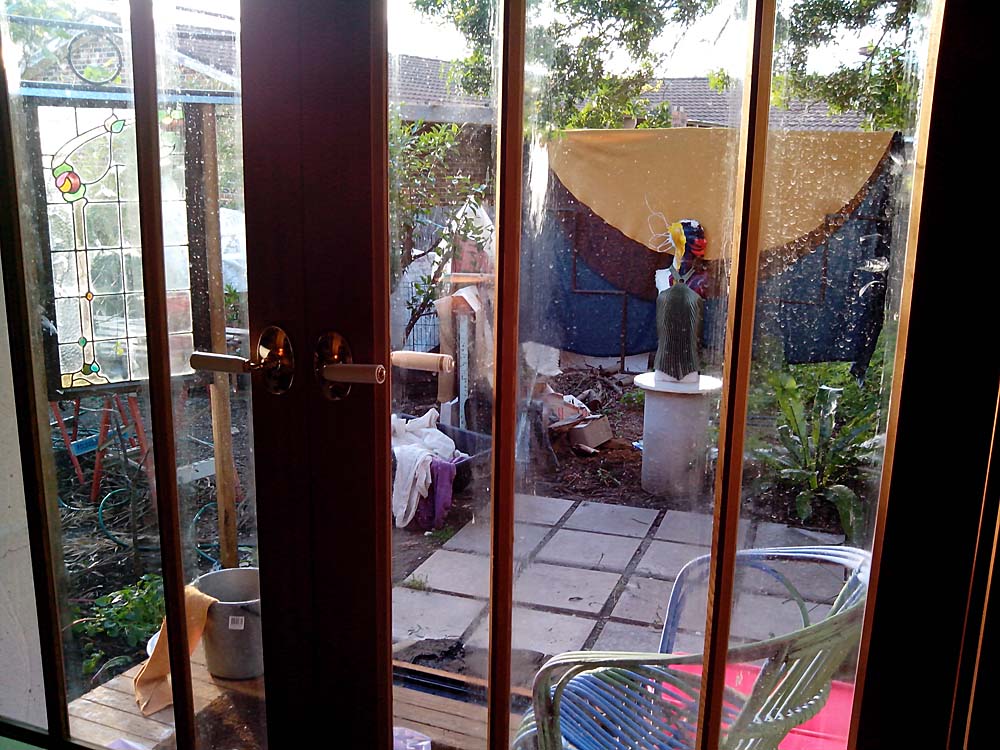
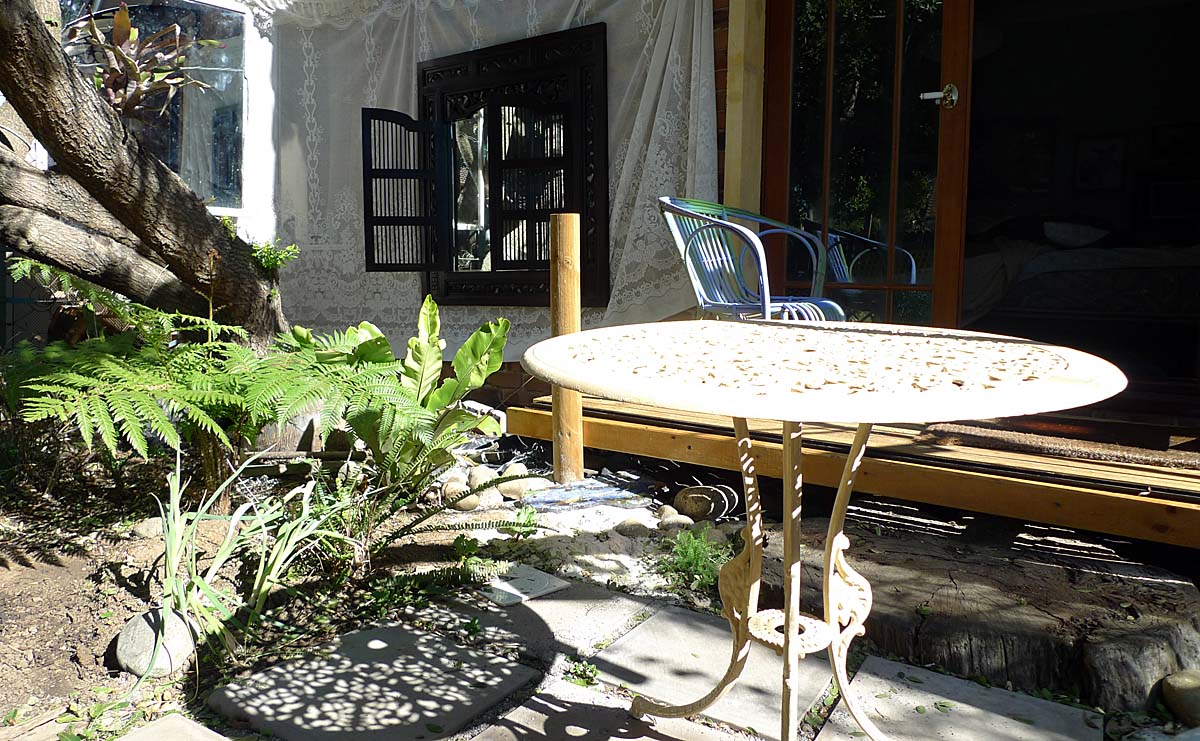
Several things came together to make change possible. I have now achieved that change by installing French doors in place of those nearest windows, removed that fence, formed a recreational space, screened against neighbours and will next work soildly (nice mistype) on what is workable sunny garden space for several metres to the left of that photo above.

We work with the scrounged and found. Or ebayed. As were the French doors. Some assistance with cutting out the windows. Then detailing by me, including making sculptable pillars from stack of Hebel blocks beside the doors, a step-out landing, some paving, etc. A slice of ancient tree trunk vomitted by the creek onto our now-sold block off the Tuross in a 2010 flood.


And viewed from the guest bedroom, inside that door, provision of light and air...


and escape to the outdoors, still a construction site:


... where I have brought together an array of materials, some found years ago, one acquired in the 1960s, badly damaged but perhaps 800 years old. She who stands guard out there, been round here and there since the 1990s, variously painted and adapted, now clad for once... who is she? Isis [see  footnote ***]
REMEMBER YOU CLICK ON ANY IMAGE TO ENLARGE ALL
CLICK AWAY FROM THE ENLARGED PICTURES TO RETURN TO TEXT


Far from finished... perhaps it will never be finished, there is enough nature around and within it to ensure evolution. The modern metallic sculptural flows are the way it happened to alloy wheels and engine block of a burned out car we discovered in May. Now inset into routed slab of paulownia harvested from former farm, in turn fixed to the front of a latticed panel of Douglas fir from the Berry tip. The mirror, edges to be painted, alters and increases light and space. The paving is 10 degrees or so off from square with the building, so rectangularity is denied conformity; unsquare. The square pavers will diminish in form as herbs grow, so far just scavengings of mint, yarrow and marjoram from other corners of the garden. All adjacent to the rhubarb mixed with iris, tree fern and birds nest fern, adding edible colour and dis-regimentation and avoidance of silly segregations. The stained glass window (farm shed/garage sale, Foxground 2010) is a rectangle making the case against rectangularity too. It catches the morning winter light; in summer the young quince tree, bare sticks in this pic above, will grow up to cast shade over and part swallow it.


To look down is important, achieving contrasting forms... also note that the Pistacea chinensis is already in this windy spring casting down its delightful oval contribution of leaf litter.
Peaking out to the right of the violets is a false tobacco bush seedling S. mauritianum
which I removed from roof gutter above, potentially bushman's toilet paper :-)

and in this photo another mirror has crept in... and morning sunlight adds more geometry


*** Regarding Isis: a very significant addition to my back yard:
...at a comparatively early period in Egyptian history Isis had absorbed the attributes of all the great primitive goddesses, and of all the local goddesses such as Nekhebet, Uatchet, Net, Bast, Hathor, etc., and she was even identified as the female counterpart of the primeval abyss of water from which sprang all life. From what has been said above it is manifestly impossible to limit the attributes of Isis, for we have seen that she possesses the powers of a water goddess, an earth goddess, a corn goddess, a star goddess, a queen of the Underworld, and a woman, and that she united in herself one or more of the attributes of all the goddesses of Egypt known to us. Source here
===

With Ceres in the front garden, this omnideity Isis seems well placed in this evolving mix of built and natural out the back.

Thursday, July 25, 2013

Mineral needs and interactions in plants (on soil)

I am reminded by recent learning that I need to look carefully at mineral interactions in the soil and the needs of plants.

I have been adding dolomite (a limestone with high proportion of magnesium) rather than normal agricultural lime (limestone essentially calcium carbonate) to my soil.

I have focused on magnesium because the use of lime not dolomite in broad acre farming almost certainly contributes to a magnesium deficiency in much commercial food, there being a need for calcium and magnesium to balance each other in nature. In humans many problems arise from calcium coming away from where it should be, causing deterioration in bone and muscle and contributing to nervous and cognitive disorders and poor metabolism.And while pharmacies and supermarkets are littered with calcium supplements, you really need the magnesium to get the calcium back where it belongs and staying there. You can get lots of information from the web on this, it's a good exercise in wading through 'marketing science' for facts.

A recent email from someone in the US (curiously in a discussion about a lemon tree in a pot in the UK) drew my attention to the fact that calcium is more soluble compared to magnesium and in high rainfall environments calcium deficiencies can rapidly arise, as also is the case with other minerals which are highly soluble.

We've had a lot of rain, some parts of my garden good, some not so good... 

So... I need add calcium but also to check my soil pH, must get a pH test kit, lent mine to someone...

pH is critical (see this introduction): an industrial way to achieve it is to add stuff to try to get the balance right. On the other hand, achievement of a high humus healthy soil, crowded with life, should itself nudge the soil towards the right pH.

Source here, same link as above


But it is also important to have an awareness of mineral availability. There is a thing called Mulder's Chart which can be found in many places on the web. In fact two charts, for animals and plants. This is the chart for plants, which I have borrowed from this site. This is a particularly helpful presentation, with its text, explaining the nature of interactions. I wanted to report here who exactly Mr/Dr/Prof Mulder might be, but mainly I got links to The X-Files.

Click on image to enlarge chart. Go below the chart for a bit more...
borrowed from this site


This becomes relevant when you find problems which may be identified in plant leaves. Here is a citrus leaf from my partner Helen's garden.

 
 It is growing in red sandy-clayey soil on a slope, recent heavy rains, rapidly drying soil. The task ahead is to work out what may be ailing the tree, and how to ffix it. Ideally we just help the soil fix it. There are pictorial guides to deficiencies evident in the coloration of citrus leaves. Try this, or this, or this... see if you can find better on the web, if so use the comment box.

My opening perspective is this:
  1. The tree is young, young citrus tend to struggle at times and much self correction is possible;
  2. The rains and wind have stripped compost, manures and protective mulch, first leaching away soluble nutrients, perhaps drowning a lot of microorganisms, and then drying the soil severely;
  3. When roots go deeper, the problems may reduce, as the tree gets bigger and feeds from more damage resistant levels of the soil... but under the tree the soil is pretty shallow because of the slope;
  4. So start simple: 
  • Use a broadfork and use carefully at and beyond the drip line, lifting soil, enabling water and nutrient entry to lower levels of soil;
  • Check the pH, as appropriate then add lime and Epsom Salts (giving the tree magnesium and highly soluble sulphur) and a bit of dilute urine (see earlier blog entry on urine in garden) for nitrogen and much more;
  • Throw in some rusty nails for possible iron deficiency (citrus love iron);
  • Add compost and well rotted manures;
  • Re-mulch (the protective layer, high in carbon, slow to rot, resistant to weeds coming up. Plant  bushy legumes (peas, beans) into the mulch and
  • Water well, deeply and not daily, allowing water to go deep and roots to follow, not spread near the surface.
May sound complex but not really that hard, and a good support like this should help for some time, as the tree finds its feet.


All this arising from discussion about a neglected lemon tree in a pot in England... Stimulus from small issues drives on to wider thought!

Monday, July 22, 2013

science achieves some understanding of crop rotation


There is an interesting article at Science 2.0 on research providing some eye opening discoveries about the benefits of crop rotation. One could perhaps also apply the information revealed about rotation to the practices in permaculture of mixing crops as well as rotating them... but one step at a time... this is scientific progress, in the sense of science waking up to the smartness of nature, looking at broad issues.

This is a major finding, quote from linked article:
"Changing the crop species massively changes the content of microbes in the soil, which in turn helps the plant to acquire nutrients, regulate growth and protect itself against pests and diseases, boosting yield," said co-author Professor Philip Poole from the John Innes Centre.
"The soil around the roots was similar before and after growing wheat, but peas and oats re-set of the diversity of microbes."
A key to the research has been a new ability to look at organisms across kingdoms:
Analysis has previously relied on amplifying DNA samples. This limits scientists to analyzing one taxonomic group at a time such as bacteria. It also means that everything present in that group is analyzed rather than what is playing an active role. Every gram of soil contains over 50,000 species of bacteria so the task is enormous.

There are relatively fewer actively expressed genes - RNA. It is now possible to sequence RNA across kingdoms so a full snapshot can be taken of the active bacteria, fungi, protozoa and other microbes in the soil. The research was carried out in collaboration with the University of East Anglia and The Genome Analysis Centre on Norwich Research Park.

"By sequencing RNA, we can look at the big picture of active microbes in the soil," said PhD student Tom Turner from the John Innes Centre.  "This also allows us to work out what they are doing there, including how they might be helping the plants out."
In sending a link to this article to a friend in Nebbi, Uganda who is an IT businessman and recently begun as small farmer. We have been discussing crop rotation. I commented on the article under discussion:
Science and technology makes too many humans think that the world is somehow just a lot of machines. People are so strongheaded about their own importance that they don't notice the way the world shapes itself. Industrial farming seems to start with the notion that a farm is an empty space which you scrape bare and load up with human genius, but we are just a not so bright, very dangerous species. And you probably notice that the humans who come as tourists may have the power of money but often so disconnected from the earth that they don't see much around them and definitely don't understand much.
Small farming at 1000 metres altitude, 2 degrees from the Equator, Nebbi Uganda, photos Vincent Ulargiw.
I am including photos to show natural soil quality and normal patterns of crop diversity.
  
Waiting for the rainy season, when the banana clump will be thinned and replanted, etc.

At Science 2.0 I commented:
You write:
" The findings of the study could be used to develop plant varieties that encourage beneficial microbes in the soil. The scientists are already investigating the possibility of engineering cereal crops able to associate with the nitrogen-fixing bacteria normally associated with peas."
Perhaps more importantly it should point to the great limits of conventional agriculture's understanding of and disrespect for the soil, and lead to more sensible practices within nature, rather than in clearing away nature and trying to do a chemical pallaver on top.

We can also draw on history, to see the succession of civilisations wiped off the map because of lack of respect for the soil. The issue is urgent. Peak soil is closer than peak oil. As is peak water.

The hunt for GM smartish things tends always to produce items demanding more water and or more chemical fertiliser because of designer weaknesses of plants. And more water ceases to be available while the flood of chemical fertilisers supplant and wipe out the populations of soil organisms discussed as important in this article.

This research is important in that it has, with its ability to examine a wide variety of organisms, unveiled realities which are not apparent in reductionist up-close studies. More important (for understanding of nature if not for securing corporate funding) to understand broad natural processes than immediately dive back away from the fresh air this offers into the worm holes of reductionist fiddle with molecules.
 We need to enhance understanding of soils and attitudes to water, getting more water retained in improving soils. People often talk about organic farming and sustainable farming with answers about the importance of what is fed to human consumers. The big question should be: "If I farm for 10 years or 50 years, will the soil be better than it was when I started?"

Thursday, July 11, 2013

intellectual strengths of birds; observation powers of people

The Guardian has carried a wonderful report on the capacity of cockatoos to solve complex puzzles. Screen shot inserted here to entice you.

from http://www.guardian.co.uk/science/grrlscientist/2013/jul/10/lock-picking-cockatoos


I offered the following comment:
If you consider the intricacy plus force involved in extracting pine nuts you get the idea of everyday cockatoo life. Some Australian cockatoos seem very keen on lemon seeds, trashing the fruit. A particular generation of fancy tall street lights in Canberra were swiftly unlatched either for fun or for the rubber seal.
I think we underestimate or often just fail to see the extraordinary daily tasks of wild birds to eat. After a week of heavy winter rain in my southeast Australian garden recently the smallest birds are not seen, many perhaps not survived as seemed the case after fierce summer heat this year. The Eastern Spinebills frantically flitting for surely dilute nectar in scant quantities from downward facing flowers on flopping branches of Chinese lantern bushes, Abutela? Not a multistep puzzle but requiring flight, balance, twist and persistence generally invisible to and beyond gym-oriented Homo urbis. The satin bowerbirds came after the rain eased, out of the forest to grab whatever looked tasty in the garden.
Ordinary bird life is hard, complex and necessarily involves innovative braininess just to be alive. Big birds like cockatoos have the advantage of size and surface to volume ratios that mean they are less vulnerable to environmental stresses. Which means they have time on their hands to do research and innovate; the connection between time on hands and outcomes of an interesting kind deserves research!
Don't forget in review of larger bird cleverness the kites in northern Australia, alongside indigenous people when they use fire to hunt and produce preferred food bearing landscape. Some kites (bigger corvids) pick up burning sticks and carry fire to new fronts to drive out prey for them. Intelligence, observation, memory, participation, bravery, imagination, craftiness... I think a lot of human judgement about so called dumb animals arises from our own failure to note what is around us all the time.
.... But after reading your report, I'm not walking down my cockatoo infested streets looking like that dude in shades, and definitely not while carrying my Rubik's cube!

I choose not to place google ads on my blogs and web pages. But like most, The Guardian derives revenue from such. I note that in this cockatoo intelligence story, the google ads were these below, on the day when I looked and living where I live. You will get different.

I wonder if it's cockatoos or people that are being trained to do 'monkey tasks' (dear monkeys I apologise for the term, which is meaningful, I know, only within a prejudiced, narrow Homo 'sapiens' kind of vernacular, otherwise I'd have to say something longer, like "trained to do artificial and life-sapping researcher phony tasks like domesticated cockies get to do in the post-industrial age of subdivided and subdivided focus for doctoral students").

And where I wrote in that comment that: "...the connection between time on hands and outcomes of an interesting kind deserves research..." I don't think time on hands includes time at computer. Must run... rain stopped outside activity for a week or so here, as did pleurisy.

==================

But time on hands, for cockatoos? ....  I suddenly realise and run back to add this.

I suppose domesticated cockatoos, which the researchers assert to be smarter than wild cockatoos, have more time in their hands, and are waited on, fed, cleaned-up after. Life of some human children.

Whereas the big cockatoos and their close relatives in the wild,  in the morning after a cold and wet night, do not have to run hunt food like little birds, are not trapped at their research desks or perches with humans sharing their wisdom***, but fly free to find a powerline to sit on or swing around on in the sun, to natter, kiss and fiddle with each other.

Now who's smart in that comparison?
________

*** I knew one 'domesticated' cockatoo, intellect enriched by human company, who used to respond to the doorbell by shouting "bugger off, there's no one home!" ...  Indeed.