Saturday, September 13, 2014

spring arrives, pruning to discuss


They say that blogging is going out of fashion.

I find that writing the blog helps me think about what I'm doing. So if there are gaps over time, just assume I'm thoughtless at that time ... :-)

 But I'm also astonished that people do look at this blog, blogger tells me that 1067 people looked at these pages during August (not including my looking). So that's a nice impetus to keep it going!

Spring is arriving in southeastern Australia. And so this is the view east from Helen's kitchen at 6am early September. We get to summer time in October.

not a UFO, a reflection of the kitchen light

There's little time left for pruning. In the last few weeks much thought about how to prune the mulberry.


Consideration of both how to get fruit (at least for the birds), how to keep building the launch tube shape, how to keep it down so that the view of the mountains is not obscured.

And now to work.

The bird cages, kettle, etc, provide weight to bend branches - sometimes we cut, sometimes we load, apply traction
the swimmer was installed with the help of wwoofers last spring
The young lady wwoofer from Hong Kong, with a political wink
called her "Goddess of Freedom"


Meanwhile at my place, lots of pruning done already, some months ago, some more recently by my gardener Renay, while I have had one shoulder in a sling.

So here is an account of varied purposes in pruning.

Elements of thinking:

  • gardens, nature, are not static: change is fundamental, conventional suburban gardening where a pattern is stamped and maintained is a form of death, not life
  • nature left to its own course may according to some develop disorder but in truth, it's nature's order in which it's not likely to be very concerned about people
  • so for food or for shifting the environment, for light, for aesthetics, for ways to walk etc, we intervene
  • Plants grown from seed can be left to take their natural form, but be wary of those that may grow to 20 metres
  • Cutting into a tree has hormonal effects. You can't just leave this bit long, make that bit short. When a limb is removed, or its tip removed, hormonal signaling with auxin occurs below the cut, promoting fresh vegetative growth. So the act of cutting produces more vigorous growth from the branch you cut... which means of course that once you begin to prune something, you have a responsibility to keep pruning. Some imagine it an act of kindness to a garden to let trees run unpruned. But if pruning is not followed by more pruning, the tree will grow dense and wild and susceptible to pests and disease
  • Grafted trees must be pruned, they are not natural. A grafted tree has two parts; [1] a 'root stock', a variety of the genus that grows vigorously in the ground... the head of this is chopped off [2] a 'scion' which is a cutting of a desirable fruit which the horticulturalist is able to attach so it grows on the strong rootstock. The scion is often not a variety that will grow well on its own. Also, many varieties of fruit produce seedling trees that will produce quite different fruit. So a seedling may produce something of unimagined quality... or not. So the small range of commercial fruit remains a consistent product because it is grown on grafted trees. Seedling trees also tend to take many years to fruit so it's an interesting experiment to grow them, if you want to wait and have room for lots of trees that may or may not be useful. Home gardeners also have access to grafted trees that are supposed to remain dwarf. 
===
To begin with this orange tree. Oranges can grow very big, much too big for suburban gardens. If foliage gets too deep or dense, bugs can be very pleased and in damp weather diseases proliferate. The fruit, like my neighbours, need light. So this tree has had a metre taken off the top, bringing it below the fenceline, spreading and open to the sun.


and you will see in this detail (photo below) that the tree's response to pruning has been new fruit buds and new leaves. So we pruned at the right time, to produce this vigour in September. On hot days in a couple of weeks the air at the front of the house will be full of orange blossom oil.

Do note also that the tree has been well fed with compost and a fertiliser including autoclaved chicken manure, blood and bone, sea weed and fish meal.


Thursday we had a hot dry wind so in planting some new plants it was useful to put them in a little water in this old pond. Notes and map on the table to the right. The hedge behind is of Hakea salicifolia - the hedge grew accidentally but usefully to screen from the road. I had put down some wood chips in 2008, there happened to be seeds in the wood chip delivery. The hedge is now trimmed annually to chest height. All the trimmings go into the mulcher, we make our own mulch these days, or combine our woody mulch with sugar cane mulch to provide [a] weight to the cane mulch so it doesn't blow away and [b] a mix that sticks together and blocks light better than wood chip alone.


This white sapote has been growing vigorously. It is said to grow to 16 metres... 
So I chopped its head off several months ago.
You can see some modest winter growth, the smaller leaves.
Apart from space problems in the garden, a tree which produces lovely fruit far above the ground
is strictly for the birds!


This is interesting, even though you may think it looks more dreadful than interesting,,, but I wasn't going to pull the heavy table away just to give you a classy photo. This is a tibouchina which has struggled for access to light, hence sideways. It grows lots of flowers on skinny brittle stems. It has recently finished flowering and we opted to go with the stream- or wind-battered look, removing old flower stalks. It responds well to a hard prune.


This is a waratah or telopea, the emblem flower of the state of New South Wales, but a fairly rare and isolated plant. It flowers in September, but this year not so many flowers because with the strange weather earlier in the year, it also flowered in March. These are mainly found hiding in the forest, not in suburban gardens. Easy to kill many Australian plants with general fertilisers as they have adapted over geological time to soils with little phosphorus in them... so if you feed them with a general garden fertiliser with high phosphorus they may die swiftly.


detail of above


Lemon, espaliered. 
North facing, now very productive, but time to prune it again. 
In pruning this, I will remove crossing branches and continue to spread it along the trellis. 
String and wire help in the shaping.
And I will prune off tips of branches that I want to grow most vigorously, see reference to auxin in dot points earlier.
Chives growing at foot are convenient to kitchen but also may control aphids.
I think the build up of aphids on fruit trees, roses, etc also reflects soil nutrient deficiency, 
so important to work on that, not just repellants.


The large bush in the centre of this photo blow is a camellia which has just finished flowering. It has summer value in shading the front of the house... but it needs to have a metre chopped off the top now so that it regrows to a height which means we can share the flowers with the birds and to avoid dropping tree litter in the roof gutter.


North facing sunroom window, backyard. This accidental seedling peach provided full shade for the window last summer and will do so again this coming summer. Meanwhile, hard pruned in May for maximum light in the window, new shoots beginning. (click on any photo, all will enlarge)


Pruning this fig has also meant more light in the garden since autumn. 
Also important because figs can grow very large and the fruit is very attractive to birds. 
No point in having fruit beyond human reach.
Opening the tree like a vase means more light in this next growth season
and also means less dark dank spaces wherein thrip populations swiftly grow (and hungry birds lurk)
So you get the tree in shape now and be prepared to trim off branches and leaves that may suddenly be infested with thrip.


Bananas are in fact grass plants. They constantly produce new suckers (new shoots from the ground)
The objective is to have one trunk for fruit now (please, please), and a follower for next fruit. We have added potassium to the feeding regime in hope of supporting fruit development.

Well, this is a piece of a large cypress removed from the front yard six years ago.
For a time it was a bench in the garden.
Recently stood up and with chain saw 
given some little touches to enhance abstract human form


and in the night...


It doesn't matter what you do with tamarillos, they seem to know exactly how tall they want to be, go to that height and stay there. Very convenient. A nice overarching shade, on modest trunk. We hope to get hundreds of fruit from these two trees this next season (February-July 2015).


Asparagus,
In first several years, not steal too much. But now this year we are hoping for a good crop. This the size of shoot you can find in one day's growth. Important now to keep cutting as they emerge and encourage underground proliferation. If you let them rush up to leaf and seed, that's the end of the crop for the year.
Picked fresh, eat fresh, no need to cook.


This is a quince, selected for foliage and form as well as fruit. It occupies a position north east of bedroom French windows at back of house. In the winter without leaves, sun streams in in the morning. In the summer we want shade. Leaves coming.
I have removed a couple of branches which were crossing over others. 
And have added a milk bottle with about 1kg (1 litre) of water, to gently encourage that strongest branch to bow outwards.


Light and shade, comfort, sensuality and aesthetics.
Watch the dog. 
In winter the dog will remind you where the sun falls by seeking and sitting in sunlight.
On a warm spring day, every poodle deserves to make its camp in the shade of the fence,
 among violets, with freesias at nose.


This is a big job to be done soon. This Pistacia chinensis provides wonderful shade behind the house but is leaning over too far, descending lower in recent wet weather. We have to get weight off the top and perhaps prop the trunk.


Everything changing, always. Wonderful!


Saturday, September 6, 2014

little films, little events

Helen's north side, southern hemisphere sunny side, has removed a tree, a cypress to which they seemed very attached while reluctant hitherto to understand how very big it had become, would become. Removing it has given much more light to Helen's front garden, which offers new opportunities for gardener and plants.

The cypress had had the top cut off some years ago in hope that its growth would thus be limited. in fact it meant multiple trunks developed.

This first movie shows some skill on the part of the arborist in dropping the last trunk.


and this is something entirely different. One living space in my house has a very large window to the south, facing a metal fence and the wall of the next house. a very narrow garden bed, beside a concrete path, no sun in winter, blistering dry and hot in summer. When I arrived in 2008 I planted two Kennedia rubicunda, Dusky Coral Pea, which has over-run the whole space, turned the view green and created summer cooling. And in this springtime, red flowers with nectar for red wattlebirds


Tuesday, August 19, 2014

late winter/early spring rain after months dry and windy

VioLaceus and Tenuirostrus in the garden, along with others. The Satin Bowerbird and Eastern Spinebill. Rain has brought the birds rushing about, after a long, very dry, very windy winter blowing hot and cold.

The garden has survived, despite madness, with a poodle in the backyard that thinks it's a rabbit, digging and digging, and rabbits (initially one, then become three) in the front yard, thinking they are poodles, wanting cuddles almost, so tame if they were in America I'd run up a tree fearing rabies. You come out the front door at 2 in the afternoon and there on the concrete beside the car, in surprisingly warm winter sun, is a run-away-from-home rabbit, sprawled like a poodle, fore legs forward, back legs backward, waking up and saying hellooo what are you doing here?


I chose the winter to have the rotator cuff repaired in my right shoulder, having had six weeks in the sweaty summer with arm strapped immobile, for left shoulder. An operation requiring three holes, a router, a vacuum cleaner, a drill, five round headed screws, a sewing machine and string, managed I think by a ferret. At least, it has felt like violent ferret work in the weeks since 11 July. The garden-virtue of doing this now is that the garden has at best grown modestly in cool and dry, and management possible with weekly visits by my gardenologist Renay, assisted of course by rabbits and poodle. And when I have been absent, most of this period in recliner at Helen's house, Renay has had the conversational assistance[?] of retired but for once not retiring gentlemen neighbours, the most persistent of whom never crosses the road to see ME!! I must go buy a blonde wig. Also the ex-highway patrolman, asking with kind concern about my health but who seems resistant to my expressions of concern about the freedom he and his wife have given to these rabbits, taking them in, giving them a little house... and leaving the gate open for them. I say he's harbouring a felon, he just says with widening eyes that his wife thinks they are lovely. I have to get to him and show him the 1995 Regulations under the New South Wales Rural Lands Protection Act, wherein it sayeth, terrifyingly:


In case you read that down to the end Wikipedia adds this alarming discussion about curtlilage and "separate intimate activities":
In law, the curtilage of a house or dwelling is the land immediately surrounding it, including any closely associated buildings and structures, but excluding any associated "open fields beyond", and also excluding any closely associated buildings, structures, or divisions that contain the separate intimate activities of its own respective occupants with those occupying residents being persons other than those residents of the house or dwelling of which the building is associated. It delineates the boundary within which a home owner can have a reasonable expectation of privacy and where "intimate home activities" take place. It is an important legal concept in certain jurisdictions for the understanding of search and seizure,conveyancing of real property, burglary, trespass, and land use planning.
In urban properties, the location of the curtilage may be evident from the position of fences, wall and similar; within larger properties it may be a matter of some legal debate as to where the private area ends and the 'open fields' start.[1]

Absolutely.

I also have to explain to the highwayman that the control problem could be larger when there are 1.8 million intimately active rabbits in our cul de sac curtilages, see this. I'm not calling the ranger, that would be uncouth ... and he's unlikely to do anything given that there are villages around here where at dusk you have to pick your way over the lawns between kangaroos, wallabies AND rabbits. 

Meanwhile, back for a bit from convalescent decrapitude with immobilised arm at Helen's, I let Ralph poodle out the front door ahead of me in the mornings and he chases the rabbit/s back home, so fast no photo possible. Quiet curtilaginous cul de sac, safe for such freedom for a car-blind dog.

————

Anyway, we've had near 100mm of rain in a couple of days and everything in the garden is happy. (Poodle not included, he avoids going out in the garden in the rain.)

At this time of year as we eat breakfast we see the Eastern Spinebills rushing through the nasturtiums, main flower just now in the backyard. In the front yard they currently have azaleas and Chinese lanterns.

Yesterday interesting observation of bower birds. A year ago I scattered around paving in the garden a number of small blue ceramic tiles, about 1/2 inch square. They've all vanished now. The male Satin Bowerbird commands a territory (Graeme Chapman suggests 5 per square kilometer) and retains his hypnotic control over women by building a bower wherein he dances. I do not know where the local chief keeps his bower, but there's lots of bush nearby. Here are two photos I took several years ago of bowers. The first in hot dry country in the Northern Territory, only white shells available for ornament (or shells bleached white in the weather), the second from where I used to live 20km from here, next to a country post office/store, shedding plastic tape, bags and lolly wrappers. What we can't see but the lady bowerbirds can see is that the saliva used to stick the bower together glows iridescently at frequencies we can't see but they can.


We could watch dancing in that second bower but that ended when a large alpha feral cat got the bowerbird. I wrote a piece broadcast on Radio National, about the ethical ecological dilemma involved, the cat having also 'controlled' the antechinuses (marsupial mice) who had been eating the peas. We are strangly cat-deficient in this street, very unusual. There are tens of millions of feral cats in Australia. The rabbits-uneaten-by-cat eat flowers (preference for yellow rather than purple), mondo grass and, again, peas. Not so keen on rocket, which is perhaps a bit peppery for a pampered palate.


THIS IS NOT MY VIDEO, JUST FOUND IT ON YOUTUBE
watch and smile, grown men may weep, women may laugh loudly 


acknowledgement to 'anyoneseenthisyet' of YouTube
=====

I note that, with no dog or chooks about, we saw several weeks ago while lunching in the backyard, mice and an antechinus. Not seen these last few days, there is currently heavy patrolling by a currawong, who may in his unmatched viciousness have wiped them out. It's rotten, rotten news when currawongs become dominant. It seems to happen, as I previously observed in Canberra, when small bird populations have been diminished by savage weather: hard rain, fierce heat, long dry cold. The small birds have much less body weight and volume relative to surface area and have difficulty surviving overnight in bad weather. As their numbers decline, currawongs seem to move and hunt more territory more vigorously. Helen's garden has a big problem with Indian Mynas. We've bought a trap. To deal with the currawongs I may need to teach the poodle to fly.


————

Anyway, back to yesterday. I had planted yet another small thyme plant several weeks ago and to mark it for me and for Renay arriving in my absence, I had cut a piece of blue punnet with the label 'common thyme' thereupon, and stuck it in the ground. The poodle initially followed my example and tried to dig everything up, then kept nicking the blue name tag... but eventually his boredom arrived sooner than my persistent correction.

Yesterday, however, I look out the window and see this:


... what (between nasturtium and rocket) looks initially to be a female bowerbird, of whom great numbers steal fruits, but this bird, with the blue plastic label (the thyme plant is behind the palm) in mouth, must be a juvenile male.


image cropped and sharpened in Photoshop

 The Australian Museum advises
The adult male has striking glossy blue-black plumage, a pale bluish white bill and a violet-blue iris. Younger males and females are similar in colour to each other, and are collectively referred to as 'green' birds. They are olive-green above, off-white with dark scalloping below and have brown wings and tail. The bill is browner in colour. Young males may begin to acquire their adult plumage in their fifth year and are not fully 'attired' until they are seven. - See more at: http://australianmuseum.net.au/Satin-Bowerbird#sthash.lcST2pRD.dpuf


Soon after, the boss of the neighbourhood arrives...


image cropped and sharpened in Photoshop

...and begins to move around, gently driving the young bird away. In this photo below, he's on a wire fence, visible at the top of the timber pole sculpture, staring down the teenaged upstart.


image cropped and sharpened in Photoshop
Now you see why he's a 'satin' bowerbird
For a while the young bird tries to stay round and hide in and nibble at rocket in a raised bed, but the boss bird, who has taken no interest in the blue plastic [note 28 August: it's vanished now], knows where the young bird is and eventually the young bird flies away. I don't have a picture of the bird after it left, but it's so hard to see (follow yellow arrow) in the middle of the rocket, it's almost a picture of when it's gone. I don't know how far the boss male flies from bower to get here, nor do I know how often he does the rounds to stop this kind of upstart raid, but it must be a major spring preoccupation. I wish he'd chase the blackbird away, it damages things and it out-competes too many native birds.


Click on any photo to enlarge all of them, 
then you'll see the yellow arrows in the photo below.


image cropped and sharpened in Photoshop

Well, it's nice to write something... the business of persistent pain makes focus difficult and was a major contributor to loss of momentum with novel (bits of it here and here). There is a degree of alarm among many writers about the fate of the novel in the current era, see these musings, links [1] and [2]. There is also a very serious problem that the way people seem entertained seems to have shifted alarmingly in just a couple of years. I am away from FaceBook and Twitter and LinkedIn, but cannot escape the misery and weird political fantasies of current news, updating day and night. 


I wrote this comment to a discussion at The Guardian about our Prime Minister at the weekend.


The garden is a landscape of ideas, but at heart the pen is mightier than the shovel. At least for the brain cells of an addicted writer, though who reads anything substantial these last several years. Read with the pen, listen with the mouth, as many work colleagues used to do in Foreign Affairs. More and more the act of writing must be its own reward.


As to the difficulty of looking at my novel's text, I share the angst of Edward Gorey's Mr Earbrass and envy the simplicity of his writing misery. 


or if not the 'Continent' then Japan... So easy to write of passing parades, rather than confect a larger, coherent structure of literary merit. The garden has the good grace to keep writing itself, hunting its own coherence and evolution or revolution when you look away, muse unto itself. Alas, not the novel. 

Sunday, May 18, 2014

new tool, new space, more light... And ending the tyranny of flatness

A complicated title. A number of events, thoughts, issues suddenly converge and allow progress.

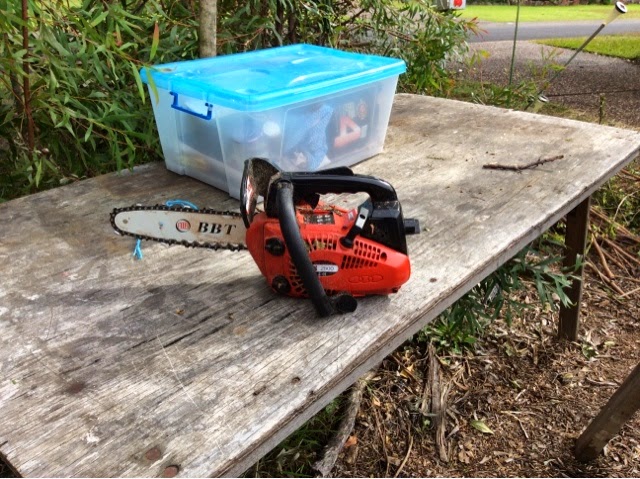
With a new helper/adviser I had become conscious of the need for more pruning, mulching, soil development, also to admit more light. I have a large chainsaw which I cannot with damaged shoulders use. So I finally succumbed to desire and spent $125 on a 3kg, single-handed pruning chainsaw with a 10 inch bar. 

Which is in fact very powerful, very easy to operate and maintain and has meant a very rapid and extensive pruning and tree-shaping in my front yard. I have been conscious that with small spaces the more you create 'rooms' the more space you seem to create. 

In a short time pruning, several hours with gaps in them, and less than two litres of fuel, we have much more light and space. And mountains of prunings. A problem with a wheel of the mulcher prevented straight line thinking and a lot of tedious mulching straight away. 

At this point I recalled recent reading about hugelkultur, which apparently lots of others had been doing for some time... http://littlehouseinthesuburbs.com/2011/11/building-a-hugelkultur-bed.html is one source of information about this notion of building wood mounds as garden structure. 

I have had little success with trying to build swales on my flat block with sandy draining soils, in contrast to Helen's success with her slope and clay-loamy soil. I suddenly realised the answer may be to build up more rather than dig down, so I have attacked one heap of prunings so far and produced a semi-dense mound. There will need to be a lot more material to fill this up, manures, mulches, soil... And water. 

Here are some photos, first of prunings stacked by the drive. 


This is a view from the street of a mound which was initially three times present height, reduced by vertical work by the chainsaw


The view through from the street, above, created by removing lower limbs from this large Lilly Pilly (Syzygium smithii)  http://en.wikipedia.org/wiki/Syzygium_smithii a large and handsome tree sometimes productive of good quantities of modest value, pretty but pallid flavoured fruit. Its branches swept the ground and with chainsaw rampant it was clear also that it nurtured weedy Pittosporum trees and worse bushes, now gone. 


New areas opened up for development. 


While around in the back garden is also a mess of prunings, seen here from a window, which will produce a mound in an area where swale building has not been successful ... Or rather, where digging of swales in bare earth has been demonstrably unsuccessful. The key is clearly in organic content, building soil humus, retaining moisture.   


Thursday, May 15, 2014

The opportunist on the loose


With help of Renay and new $125 purchase of a 10 inch pruning chain saw (3kg, one hand) a big clearing, light admitting, garden space expanding job on my front yard. Causing this kookaburra to take up post to find freshly uncovered lizards or worms etc. Sitting on top of the birdcage on top of a Corinthian column supporting shade cloth. Head turned away...


Sunday, May 11, 2014

Nutrient deficiencies

Sunday morning at Helen's, where Ralph makes known his pleasure at lying on grass... very little grass left at my place...


Renay, my excellent new horticultural advisor, lifter of heavy objects and chainsawist (I am still in lots of trouble with shoulders) drew attention to curious leaf colouring/discolouring on my quince tree. I responded that it seemed last year to go through a slow and curious phase of autumn colouring and very slow leaf drop.

But I did, following the instinctive 'no it's not' reaction, wonder if she was right and in the course of searching for information on somethng else came upon this excellent page of information on mineral deficiency.

Worth looking again at the quince leaves, the tree may not be really happy and feeding will help it and small plants at its base. It needs support also because it sits close to the wall at the eastern end of the house, has short day length.
----
I realised after reflecting on my last blog entry that there may be some general growth problems from my use of lots of mulch around growing plants, to the extent that woody mulch will tend to draw nitrogen from soil. This page has useful discussion of mulch and mentions nitrogen loss. http://ohioline.osu.edu/b894/pdf/b894.pdf 

For correction of any nitrogen and other deficiency problem I purchased some Dinofert Complete which is easily spread near mulched (and unmulched) plants and watered in, and should provide diverse nutritional benefit. I hope so, it contributes a lively perfume of diverse animal waste kind to the garden that has visitors checking the underside of shoes. Some conventional advisors recommend that fertilisers should be applied in spring, at the time of plant growth, but I am conscious that with the cooler weather coming worms are happier about coming near the surface and can be expected to come for the Dinofort, which will be of increased soil value when digested by worms.

I began looking at nutrition, the search resulting in the RHS link above, para 2, at Helen's place, as she was spreading a mulch of almost entirely petals from a large camellia hanging over her fence. As potassium is so important for flowers and fruit, I wondered if petals therefore would provide lots of potassium. Could not find information on that, There is in any circumstance not a lot of petal out there for use in mulch. The RHS link suggests that wood mulch provides potassium, slowly, which is good as potassium is so soluble in water and easily lost in sandy soils like mine. I still plan foliar application of dilute potassium to bananas, passionfruit, guava and tamarillos. 

Friday, May 2, 2014

May Day Report

About time to report on the state of my garden! I'm surprised, looking back, to find this blog is only a year old. And looking at the photos one year ago, the garden looked perhaps healthier then than now...
===

As a result of health problems including shoulder operation and prolonged recovery (five months and not right) the garden was severely neglected over a hard dry summer. The first task was to recover from drought damage. Hand watering and then rain. The tap water made slight impression on sandy draining soils, and rainwater, even though heavy, tended not to go far either. Some soils become moisture repellant when very dry.

Mulching, protecting from sun and wind, is very important. For eight weeks to five days ago we had the help (at Helen's house and my house) of two excellent WWOOFers, Emiko from Japan, David from France, who did a lot of steady work getting weeds and runaway grass under control, also some heavy work, especially in pruning and mulching. They also were houseminders/poodleminders while we had a short holiday in Japan.

Our 7hp mulcher continues to do very well, reducing heavy prunings, light prunings, paper and cardboard to a mash which I also now found it useful to combine with purchased sugar cane mulch. The cane mulch on its own bogs down or blows away, but combined with our coarser/finer mulch product made at home, it helps to bind and block light, critical factor in weed inhibition.

The five days since the departure of Emi and David has been an opportunity for me to survey and reassess. I must continue maintenance, but without the tasks of supervision and guidance and feeding the hungry young, I can look to things to develop and change.

First, however, this report. I plan to provide details of plants. Broad trends are these:
  • the hot dry windy spring and very dry summer raised big doubts about raised beds, which simply cooked. I demolished one, have two continuing.
  • a beautiful peach crop, suddenly falling to the ground, riddled with fruit fly grubs, illustrates a basic problem with soft fruit. Harder skinned fruit have a bigger place in the garden: tamarillo, passionfruit, guava. 
  • I am encouraging seedling growth of leafy greens wherever they come up. Rocket [arugola] is the most successful, though short-lived in hot weather.
  • Rhubarb had done well in the past in the front garden, in warm winter, but devastated by hot summer. Transferred to milder micro-climate in the back garden.
  • Interesting when plants find more sensible ways to thrive than you offer. I provided a trellis for two chokos (chayote in Mexico) in the back yard, they ran along this as directed then seemed to die. Then I realised one brown branch was not dead but led 5 or 6 metres (20ft) up to the top of a Pistacia chinensis and from it down through a mandarin. Up there in the top having wonderful all day sun, fruit abundant. 
  • The arrival of big crops produces culinary challenge. I hated chokos as a child, my mother's cooking of them dreadful. A pit-of-poverty horror. Then tasted them brilliantly stir-fried with butter and pepper, living in the Philippines. Now using them in all manner of dishes, something of a sticky surfaced chameleon, good in curries and stews or presented stir-fried as a green dish, perhaps with some tomato or pasta sauce. For tomato, in our house, also use tamarillo, so versatile, so little understood (often so expensive). With ice cream or yoghurt, or alone, as dessert, cut in half and pan fried briefly or added to vegetables roasting for the last several minutes, in stews, in salads. Dimensions of pleasure. My passionfruit will shortly be ripe for the first time, vigorous plants finally productive. Helen has had constant crops for months, a simple pleasure and luxury to add the pulp of three or four passionfruit to good plain light yoghurt. 
  • My garden is 30km from Helen's, drier, colder, hotter. I struggle to get bananas to produce, Helen has success. Problems of soil quality also I think, am now adding trace elements, will also add potassium, which is essential for fruit and flower development. Potassium is highly soluble, more and more I am conscious that below shallow soil at my place is a yellow-orange sandy subsoil through which much nutrient disappears and in which growth is not easy. This means mulch, mulch, compost, build soil up and up. It takes time. You have to put brain to the multiple issues.
Some more comments as we go, starting at the back veranda:

This first is a small experiment. There is a heat pad in the bottom of the box, above it there is a plastic sheet installed 
so as to make a puddle below the bottles. The bottles, with holes in the bottom, have potting mix in which I have put 
cuttings of the cherry guava bush in the front garden. Cherry guavas are tropical, I hope the warmth will aid development.
This may not work. It may be the wrong time of year. We shall see. A cheap experiment. 
As a practicality, the mouths of the mini greenhouses open the one way so as to easily top up the water. 


That project is on a stand alongside this pond below which runs from outside to inside the covered veranda, purely an amenity. Amenity is a virtue. Pump can be turned on for waterfall. WWOOFers Julie and Flory helped build that structure last year, Emi and David helped rebuild and straighten the kitchen sink support this year. It requires concrete down the hollow bricks and eventually mosaics on the outside. The trunk of the tamarillo grows away from the house, with a rope to hold it at such an angle.


Two steps on from that last photo... view towards northern boundary fence. Passionfruit galloping up a trellis after very slow start, now it will have long days of sun. The small raised bed behind enables growth where otherwise not possible because of the shadow on the south side of the fence (southern hemisphere). The tap is too high, at the sink, I need to replace the 1200mm riser with a 900mm riser, which will mean much better pressure in delivery from the tank.


Turn at same spot and look east in the morning sun. Bare limbs of peach which provided good shade to sunroom window in summer. The leaning banana I leant on later in the day and it fell. As I wished. It could not support bananas at that angle. It is a constant task to remove suckers at the base, you need just two of these grass family things going: one for fruit as soon as possible, one as the 'follower'. I think potassium is needed to get the fruiting going. Overall the best food for banana is banana, so this now fallen I have chopped into small pieces as mulch.


This year not as heavy a crop of tamarillos as last year, this tree is probably at end of normal short life, I have three younger trees growing well, two others may do well.


Beyond the bananas, now rapdily growing Bangalow palms with understorey and the hen house.


and here, next, is a vigorous tamarillo, for next year's crop. This began to race away when I covered the ground at its feet with shovels of soil from the adjacent bath containing lotus. You worry about feeding the lotus and then realise from this soil performance that myriad creatures including tadpoles and water snails have enriched the soil there.


Modest crop on this tamarillo, I reduced it to a stick head high late last year, it has sprung up in much better form than it had before. 

I would like to be moving the chickens around more, we have a holiday house for them at Helen's but the logistics and timing, caging them in the dark and running to the other place have not yet fallen into place. Meanwhile they have a massive dump of grass cuttings from my neighbour over the fence. They have clean water in a bucket, this bath tends to fill with their rakings of soil and shit, so it's brilliant for carrying beyond the far fence and spreading on the asparagus bed.

These photos are steps on around to the eastern side of the house. Rhubarb thriving in the first picture, moved from the front of the house.

The choko vine here descending from the heights of the Pistacia.


... in the shade of which some rainforest understory thrives,  air conditioning for the rooms here. The young quince tree, yellowing leaves (right,above), will add summer darkness and winter openness to the bedroom entry.
A fierce guard dog in attendance, watchful as his bone burial ground is in the far corner.


A load of prunings from Helen's house awaiting the mulcher.


This wire netting below is where I instructed the choko to grow, and where it did grow for a while (dead leaves), till it headed for the top of the trees (thin vertical trunks).  Plants are smart.
Also:
  • another young healthy tamarillo, 
  • sweet potatoes, running all over the ground, much space taken for small yield here.
  • on the left a young wampi/wampee.


A view back from this shady area towards chickens, early morning light


It's important to allow asparagus to grow after short picking in their early years, for energy from the sun to help build root systems to produce tasty spears from the ground next spring. David emptied the bath full of soil in the chook run onto the asparagus bed some weeks ago, here is great result.
The big leafed shrub lower right is a soursop, we will see if it gets through winter!


An informal stack of weeds and grasses, composting (actually 1.5 metres across). To ensure seed destruction I should be turning this more often to generate heat, but not easy with dud shoulders.


A raised bed with lettuce and leeks (some tiny), also rocket. Ready for covering against birds if necessary.


Big leaf below is a custard apple which may have a slightly bigger hope-in-hell than the soursop of getting through winter. But if it does and if we get fruit in three years, wonderful.
I am very disappointed, having bought a grape plant (miserable thing at wire, below the red plastic square), to find it came with a microscopic mite infestation which probably means no grapes can now be grown here ever...
Sage bushes in the foreground. Sage is cantankerous, wants love but does not like to be fussed.


More in the backyard: the fallen figure, perhaps a vampire, with variegated chive at her waist, cousin to garlic, yarrow below, with its (technical term) 'hairy pubescent' leaves. 
The big-leafed plant is happy arrowroot, roots for flour, see new tiny purplish shoots emerging at the base. I wonder if the shoots taste good, the link above indicates the work involved after harvesting mature rhizomes.
Behind the mesh (slight protection from Ralph Poodle) water chestnuts starting to die down, to be harvested when tops dry in winter. Parsley on the right as everywhere in the garden. 


The fig tree grows fast and far, has been pruned, as last year, to have fruit closer to people than birds next season and to admit winter light.


Marjoram, chives, yarrow and potato; a blackbird-attacked baby tamarillo, seedling moved here recently. The inverted pot is great hide, thus great trap, for snails. Leave ajar, check under regularly. None lately. Good.


More water chestnuts. The poodle is a water dog, part crossed with spaniel, thus doubly a water dog. This pond contains water and nice things to lie on.


Also a pond of water cress, peppery addition to salad and (long leaves) some type of ginger.


and everywhere possible, mint to rise through the mulch.


North facing lattice wall with now thriving (after sluggish years) espaliered lemon, chives at foot. 


In the front yard, some tiny things:
  • Blueberries (sticks with leaves) not thriving: hard to keep roots moist, not enough light here, dreadful summer neglect, 
  • Tiny papaya seedlings (pointy leaves), the cold dark of winter may get them, I will put a mirror nearby.
  • Freesias being spread in the front yard mulch for spring perfume and beauty.


Oranges: they yielded a verjus some weeks ago, it's less sharp than lemon juice for sauces or vinaigrette. Not sure if anyone else uses an orange verjus, but early fruit, before sugar development,  does not have a dominating orange flavour. Not yet fully ripe, already pleasant for eating and juicing... and indeed at this point they are not causing headaches I get from mature citrus, probably from tyramine.


In the front yard, grass disappearing, now yarrow, mint and mondo grass in mulch... with still a lot of daily weeding to control. The round leafed cherry guava at the back produced excellent fruit in late summer, hence my efforts now to grow cuttings. The fine leafed jabuticaba on the left apparently grows little in its first ten years. Whether I shall get to taste the fruit, hope it's worth trying!!


More props needed as the passionfruit goes rampant. Loaded with unripe fruit which should be the better tasting for taking time to ripen in cooler times.


There was a raised bed here (below) before, taken down with help of Chinese WWOOFers in March, the soil from the raised bed yielding seedlings of rocket, peas and some lettuce.  At the sunny end, arrowroot for visual effect as well as food.


More tamarillos, more rocket, straggly dead ivy to deter blackbirds. They don't want the plants, they want the worms and other life in the well nurtured soil.


This lime tree is going through the difficult-to-start phase the lemon went through. It gets fed and watered but is slow to grow. Small - but healthy looking. I am adding trace elements and seaweed extract now, in hose-attached spray.


The white sapote grows and grows, wikipedia says its fruit "can range in flavor from bland to banana-like to peach to pear to vanilla flan."
Oh the wait, the wait... to see if it's rubbish or great.
It is said to grow to from 5 to 16 metres.
I may cut its head off, see what happens... Some trees reproduce if abused.


and (behind the passionfruit of a different kind) a raised bed of strawberries. Chairs at the ready to support net against birds, many of whom just love strawberries.


Items I am adding in highly dilute spray, to favour growth: 
seaweed extracts, fish based fertiliser, trace elements. 
The little pot ($15) may be a better option than the big bottle Seasol.


Finally, the women who guard and bless the garden:

Listening to Pig's Tales


My wood carving now joined by my first mosaic, on loan from its collector, who has taken to the road (leaving her legs behind).


Actually, while almost all ants are daughters of the queen, these could just be a tiny band of lolling wastrel minstrel males awaiting the call of a new queen. 
Did music arise among the hymenoptera?
....  The HymenOptera Band... sounds right.


Our Ladies of Cliche, the Three Graces of Gardening,
as known by every WWOOFer: Weed, Weed and Weed.
"Oh, Fertilia, do we have to do weeding AGAIN... "


... and splendidly on her own in the backyard, Haughty Isis