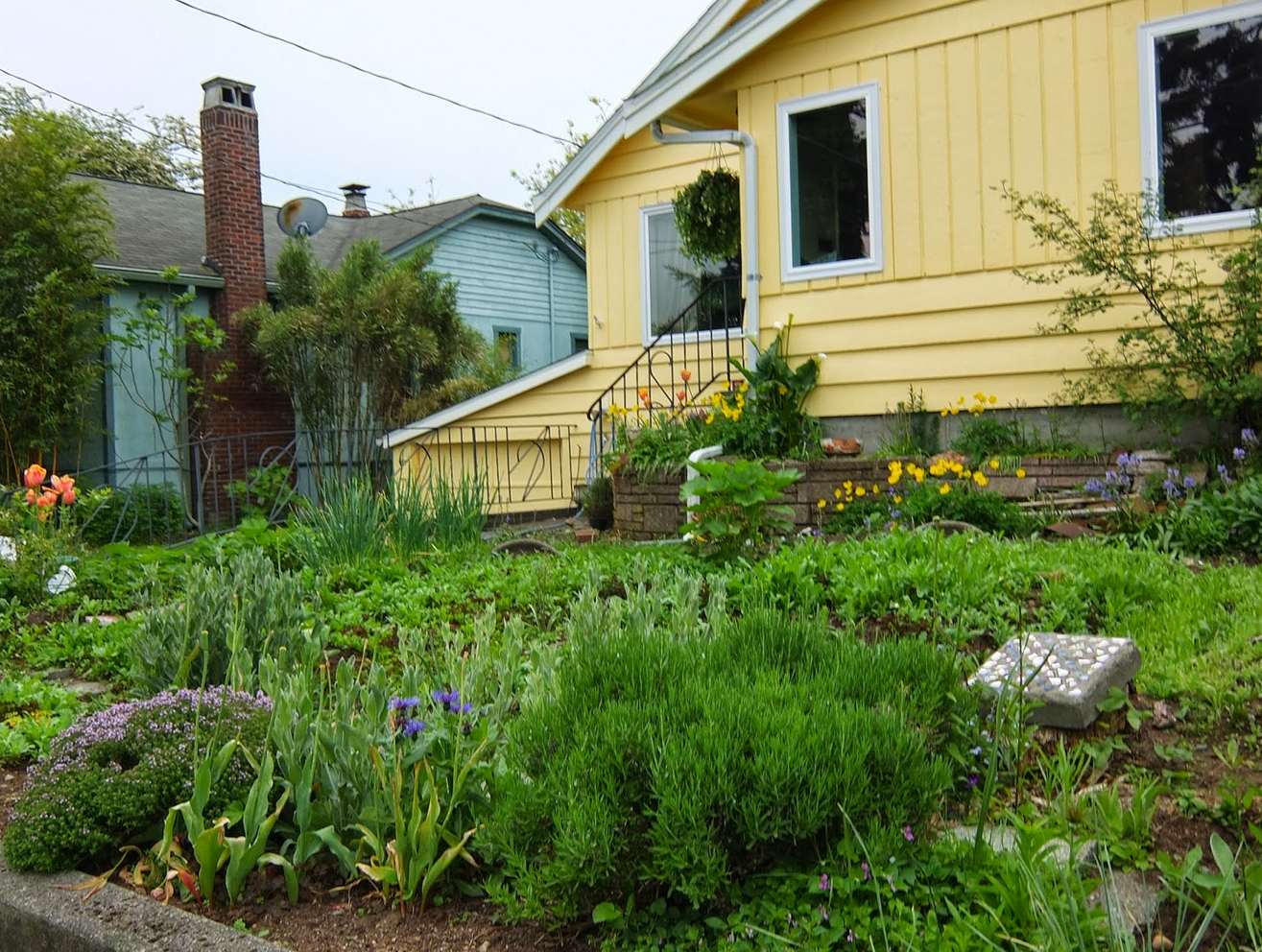
Although Helen's soil is volcanic in origin, Helen has installed two 'WormFeast' mini-and-underground composters, as described in yesterday's post. Whether, given the quality of her soil, worms will rush in to the WormFeast or rush out to the garden, we shall see. Certainly in digging to install them there were lots of worms relocated from the soil!
Helen has also built a light frame for a thornless blackberry to climb on, removed from poor performance in a dark location in the back to a brighter location in the front.
The structure being built using hard last-winter prunings from the mulberry also–for the top structure –some long whippy green branches just cut to expose the Queen of Liberty, who remains in glory, flying from the mulberry.
A WormFeast discreetly lurks at one end of a swale above that little garden. Swales are very important on this sloping ground, to catch water and get it underground, not run-off to the street. There was earlier discussion of swales here.
while further up, near the house, the second WormFeast being installed on a slope above a lively garden with apple, citrus and herbs (and of course volunteer tomatoes):
with a live mulch of thyme, dug from where it's running rampant, nearby
Meanwhile in the backyard, the chooks (non-gender generic Australian word for chicken, rooster, hen, etc) are in jungle heaven, having been moved from their well-worn pen at Dennis's house to four months wild growth at their beach jungle at Helen's.
Welcome to the backyard, the passionfruit crop has been big for months.
the three hens came here first when bought at auction end of October 2014. You can see the growth inside the fence and inside their house since they left... in January?
The Livorno (Leghorn) who is the only one laying so far made a huge song and dance setting up her space in the nest box (right hand end of the house) and producing a fine egg straight away.
These are really creature of the jungle and so happy here in this old vegetable garden run wild.
Meanwhile I will plant seed in their run at my house to refresh it for their return in some weeks.
My place is getting crowded. One delightful consequence is the increase in bird life.
As I typed at the computer yesterday, a Lewin's Honeyeater appeared at the window, lit by early morning sunlight.
Lewin's Honeyeater
For a while back there extreme heat and heavy rainstorms seemed to knock out the small bird populations, but I'm pleased to report but have no photo of my own that red-browed finches are flitting through the undergrowth. This photo is from birdsinbackyards.com.au
Red-browed finch. This wonderful photo from birdsinbackyards catches the beauty
but does not really convey the fleeting flitting way they rush through the scrub.
So... to introduce four innovations in my garden:
[1] Burying logs in garden, building log mounds — hugelkultur
I've reported on this before but this is the 'Garden Makeover' story from later... This is what has happened since. Systems working!
I discovered last year that a lot of people had been using this German term to describe something interesting they had been doing in their gardens: building mounds or filling holes with wood and then adding earth and growing on that.
As recorded elsewhere, I have been using a mulcher which reduces prunings less than 75cm (3 inches) to mulch. This of course left me with the limbs of diameter greater than 75cm, or less if bent. Discovering this buried-wood concept was directly relevant, potentially was not lumbered with a burden but in possession of assets.
I have so far made three of these gardens, in each case using mounding to achieve particular value in a location.
The first location was a scruffy space between my front garden and the road, in deep shade. Early last winter as recorded here, I filled this space with logs, over a metre and a half high, then using a chainsaw to chop and chop it down till very dense, adding seven bags of horse manure (roadside sales, $3 or 4 each for a produce bagful), lots of water, covered it all with a big tarpaulin. I then left it for months. I recorded the unveiling in January in this blog entry. I can now report that the garden is prospering. Here is a photo from recent days:
Raised hugelkulture bed in deep shade, not generally suitable for food crops
very nice place for elements of rainforest and a privacy screen from the road ..
.. and for a Monstera deliciosa, here in flower, the fruit of which needs careful handling.
The second location was also in the front yard, as also described in that February blog entry, where I wrote: "By winter I hope the passionfruit has climbed well up the trees to catch the light."
Here is the current happy situation, beginning of April:
The passionfruit climbs from the right towards the left on a piece of long-dead Cypress,
then heading back to the right towards the canopy.
That bed was given less time to mature before planting as a summer endeavour.
Later in summer I set up a smaller bed, trying to grab a bit of unused ground and lift the plants towards the light.
Initially bits of wood and manures and compost, with black plastic and weight, then adding more manure, mixed with and topping with coco peat, a sustainable alternative to peat moss, retaining both water and air and as a high carbon material, a weed retarding mulch. Here planted initially with radishes, which grow quickly, later planted with peas and rocket as weather cooled in the last week.
February: woody pruning scraps plus manures and compost, here wetted and under black plastic, held down by an old pallet.
March: covers off, extra manure and compost and coco peat and radishes taking off.
Net protection from blackbirds and bowerbirds and others.
[2] New approaches to worm farming, compost delivery and water supply below ground.
We discovered these 'Worm Feast' devices at ALDI and we bought two for each house. This video is informative, but we did not get the whole kit, nor had I seen this video before doing this blog entry. It's a good video about a good system and the value of worms.
I placed one among fruit and vegetables in the front garden. This has also been an extremely dry spot in the summer heat, so I added a feature to inject water deep into the soil, using an old terracotta pipe 1.2 metres (4') long.
Worm and compost pot on left, water injector on the right dumping water one metre down in porous soil.
There is a young blood orange partly visible at the top of the photo. It has responded vigorously.. not yet to the composter/worm pot, but to the new reliability of deep water. I added lots of volcanic rock dust to both devices.
Closed systems sold as 'worm farms' I prefer to describe as 'worm prisons'. They are suitable for apartment balconies but to my mind different thinking is sensible in a garden. Worms travel vast distances through soil, I want to have situations in my garden that worms will travel from far away to feast on. Here's a wonderful educational resource, with research for schools which farmers should think about. The tunnels they build, the droppings and bacteria they leave behind, are the most valuable things in any garden.
We have big black compost bins for reducing kitchen waste but mine has been a hostile place for worms over summer because it has been very very hot. This has reduced organic material quickly, but worms don't want to be there. The 'worm feast' introduces the idea of putting a much smaller receptacle for waste deep in the soil at relatively stable temperature, well open to the soil for worms to arrive and depart. The written literature with the Worm Feast said that from time to time I should empty the contents elsewhere in the garden but I think I'd prefer to move the Worm Feast and leave the rich content right where it is, having been put in a good place to begin. But no rush. And if it happens that things grow well close to it, then bring the gardening to it.
I placed a second Worm Feast in a rhubarb garden, and added a 100mm (4") PVC pipe close by, to inject water deep in the soil. As with the first Worm Feast, I used my corkscrew-like compost mixing tool to draw up some worms from the bottom of my main composter to add to the new device. As these are open systems we need to get the feeding right so worms don't run away. Not rocket science, more important than rocket science.
I had to use tape to hold it together when assembled.
See all the holes for worms to wander in and out. Also please note that it is not bigger than a wheelbarrow, not bigger than a chook house either—compare with the glove :-)
3 metres (10') of 100mm (4") PVC pipe cut with angle grinder.
I drilled some holes low down
and put a cap on the bottom so the water would not run through too fast.
Rock dust, seaweed and similar organic feed can be added to the water.
This is right next to a path, easy to load in the compost material
I have lifted a quantity of compost from down in the bin visible on the right.
Half the compost and worms fell back in before I took the photo.. :-)
The ingredients for the compost are mainly kitchen materials:
four parts carbon (brown, paper, etc) to one part nitrogen (green, protein, etc)
plus water, air, heat. I add manures from chickens and roadside purchase,
preferring to compost manures to eliminate pathogens
and use them for building humus, not as a raw mineral feed.
My definition of 'organic' is not about sprays and fancy foods,
but ensuring that there is more soil humus and nutrients at the end of the year than at the beginning.
Here is the starter material for the Worm Feast.
Now loaded and ready to cap.
So... learning from all that... I think that the label Worm Feast is narrow, we are doing some composting and seeking to involve worms in that. And I've added devices for getting water underground. So I think I will call mine 'Imposters', for in-ground-water-injection-and-compost-development.
I had had to buy 3 metres of PVC pipe as you see. I had also had in my front yard a huge pot which had been thrown out years ago by someone when the pretty image of peonies on the outside began to fall off. Narrowing towards the bottom it would not be suitable for compost. So after using the angle grinder to cut a slot in the bottom sort of like a piggy-bank coin hole, it has become my water injector. Alongside it I have placed three pieces of PVC pipe, putting substantial holes in the side of them for traffic between. Alone one of these pipes would not really provide a powerful base for worm attraction but together, and with manure in the soil between, they will, I hope be formidable. This is next to, just uphill on a tiny slope from, my asparagus field. Since taking this photo I have planted peas and rocket and it has rained and the rocket it rocketing in a matter of days!
IMPOSTER SYSTEM!!
The big pot is for water injection, buried half a metre in the ground.
The three compost-worm-tubes have caps which are easily removed.
Volcanic rock dust and seaweed plant food added to both systems.
I've build a platform in a warm garden space and placing boards on the perimeter, then placed black plastic sheet on the platform and over the edge to make a pond about 70cm deep. This too deep to put pots in, so pots are placed on pieces of board in the water. The greater depth of water provides thermal inertia and evaporation does not quickly remove water from the pot bases.
I began with seed, some good results, some failed results were begun while it was too hot and before I had this moisture-maintaining system set up.
I've quickly become conscious that in a home garden there is only a small need for seedling raising and I have already begun to evolve this system into a hanging strawberry garden too.
So this is a system just a couple of weeks old:
Water in trough.
Pots on bits of wood to get them up from too deep while maintaining a good mass of water.
Fill (by hand or rain) till water runs over the back corner and down into other garden area.
Seaweed nutrient and volcanic rock dust in water as well as pot mix.
[4] Root vegetable in pots
I discovered on Pinterest a lot of people advocating growing root vegetable in containers to make harvesting easy. Such as...
I have taken pots and largely buried them in the ground. Tapered pots, easy to get out and easy to empty.
I have begun adding potatoes (with the potatoes you begin with a little soil and build the soil as the plants grow) and carrots from seed. We shall see. An inexpensive experiment. Pots $3 each.
Part buried in the garden, they are unobtrusive.
some weedmat in the bottom to keep tree and other roots from invading.
Early days.
Carrots in two near pots, coco peat on surface.
Potatoes in further pots, soil and coco peat to be added as plants grow.
As you bury the potato stems, new roots and tubers develop.
Just a few photos here. It's been a hot/dry/hot/wet summer where growth has been wild in places. A lot of seedlings coming up here and there (the rocket at the wrong time of year, swiftly burned to death), also curious things also arising from nowhere, like this:
I didn't plant this, arising in the shade of bananas
and in company with aloe vera and volunteer parsley,
but very welcome, the flowers lasting weeks
and bringing a smile as you walk past.
I have experimented with some things for soil improvement, which will be in a separate blog entry.
Among the easiest innovation has been decision to add volcanic rock dust to my miserable sandstone based soil. This has produced amazing results, producing better growth and fruit generally. Interestingly, though they've been eaten not photographed, some of the volunteer tomatoes (the only ones I grow) have departed from the normal pattern of compost-origin tomatoes of being very small, to be big standard sized tomatoes. It would seem that it's not just a simple genetic shift to produce small fruit, but also a nutrition issue. The volcanic rock dust is clearly the best additive I have ever used, providing a huge array of mineral needs in a slow release manner, so that there is value, not risk, in heavy application. It is also, as a stimulus to general growth, much appreciated by worms and productive of more humus and bringing the pH into optimal range. Applied both to soil near plants and to compost and worm systems.
walking from the back veranda, life becomes crowded!
from the back bedroom french doors:
removing much of the tree shade further from the house
(hence the red prop under that branch - we had to reduce the tree
because it was tending to lean over and at risk of uprooting house foundations)
has let the sun in and growth has been rampant
... we await some colouring of the leaves of the sweet potato (kumera)
to dig and discover whether there is much underground.
To encourage layering I threw bricks into the wild growth.
See also the tamarillo, water chestnut (long reeds), chokos and mandarin. The goddess of everything Isis has moved elsewhere, being involved in a new construction. So Hanuman, the shape-shifting Indian god who can be bigger than a mountain or as small as a cat is in charge of this garden, which has changed shape dramatically this year. Hanuman was not good at identifying herbs and, unable to find the right one, lifted a whole mountain and took it to the battlefield with its herbs to save the life of Lakshamana. ... Now time to relax... but don't tell them where he is!
lots of tamarillos, have been finding new culinary uses for their sweet and sharp flavour
I've found the best harvesting technique is to shake the tree gently and the ripest fall easiest.
the tree prop frames living space outside this east bedroom.
I didn't plant this tomato, it just appeared in a raised bed after spinach crop finished.
Hitherto, volunteer tomatoes always tiny. Volcanic rock dust value?
I've never succeeded with eggplant (berenjina, aubergine, melanzane, brinjal) before,
see the fruit sitting on the mulch. Volcanic rock dust effect?
You will see that the banana flower head keeps opening,
but only a few flowers have been pollenated, up the top.
Whether this is because the weather went cold at the wrong moment,
whether because of inadequate nutrition,
whether because not enough bees (very few around until a few days ago)
I don't know. Perhaps a combination of factors.
I am trying to get more affection and attention into this awkward garden corner. Things are improving!
The young hens are growing well.
... and the roots of the passionfruit run under the hens' (chooks') space, fertilised well,
growing from next to nothing in one season, starting to provide fruit
and shade over the chook run.
The young tamarillos have huge leaves.
more pumpkins, among many things, in the front years. Volunteers.
Sorry, you didn't get to share the massive crop of cherry guavas...
this is the end of the big crop on this small bush.
That's the end of this haphazard photo collection, separate blog entry on innovations.
I was slow in discovering Pinterest, I suppose, but I have realised in a few weeks its value in enabling assembly of images and notes in a new kind of research. The concept is simple. You have a home page, on it you 'pin' picture obtained elsewhere: elsewhere on Pinterest, elsewhere on the web, or uploaded by oneself. How people go about this is an insight into mind. Not only other people's minds but one's own mind. I look back to where I began a few weeks ago and can see the evolution of ideas and pictorial sensibility. There is clearly a correlation between Pinterest and insomnia, I swear I was a lousy sleeper before Pinterest and when sleep is not possible, it, well, it keeps me from reading books... sigh...
I have observed that some people, most people, seem to engage in detailed taxonomy, dividing information into compartments, many boards, mainly practical information for the kitchen or garden, as well as art and travel.
You get wondrous insight into the minds of others. When you 'follow' someone whose collection looks interesting, you get news of what they are doing. Here's an interesting sample.
In a few weeks I have surprised myself, eventually setting up or joining 12 'boards', subjects for information, though the core of my mind's assemblage is in fewer than that. And in my assembly, the boundaries between groups seem unclear, as they do in my head.
I have two boards related to garden: one with pictures of our own gardens, one called 'garden in mind and practice', the latter containing both practical information and vision inspiration... a garden does need to serve to delight and you do need to begin with that in mind. Click on images to go there.
Hey, this image of the top of the current look of the pinterest page on our gardens makes me realise I badly need to provide an update on the gardens, growth has been dramatic this summer.
Click on image to go to the pinterest page.
It's really much as the Satin Bowerbird (including the one who thinks he owns my fig tree) does, except that most of the Pinterest human collectors-displayers seem to be women, whereas among the bowerbirds it's the men who do the collecting and displaying.
You will see that as with Pinterest, stealing other's pins is central to success,
though Pinterest kindly leaves the pin where it came from as well as pasting it in a new page.
The worries of the pinner, see below, need to be put in the context of the stresses on the male satin bowerbird! By the way, there is a short part 2, a dramatic sequel to the movie above, don't miss it!!
Another thing. We cannot see–it is not within the range of what our eyes can see–that the bowerbird's saliva paints the sticks of the bower brightly iridescent. I'm sure that there is something about that that's a parallel to the way humans identify with other boards on the basis of.. what we discover in looking at other boards. Here is the magic of (potential) expanded perception and insight in using Pinterest... if you do more than hunt and grab.
After writing this earlier this afternoon, I have wondered whether I am done with pinning after these few weeks. Perhaps for now. We shall see. Walking the dog in the evening I am reminded of something the person who first encouraged me to paint and draw some years ago said: "The hardest thing to know is when to stop." Stop painting a painting, that is. In a sense, I have painted a painting, assembled a visual ah, ah...feast, feat, aggregation, statement, learning experience... ? Done it. I did not sustain painting, I perhaps more effectively stopped painting than A painting. I think it's important to reach a point of reflection, stand back and look and think about it. To have the wonderful sensation: "who did that?"
We had two house minders to cover absence for five days, they were actually with us almost a month. Kimberly and Jeremie from Montreal became WWOOFers you dream of: excellent company, imaginative, happy at all sorts of work... family.
They very happily took on a creative project for Helen, to demolish and replace a sink base in the backyard, that which I had constructed in 2013 (with doubts evident from Helen and two French WWOOFers, David and Nicholas in photo below) had succumbed to its own ridiculousness...
The way it was.
Jeremie is a landscaper who had done a lot of dry stone wall construction, but had never worked with mortar. He built the required structure. Kim's experience has been as an office administrator. She approached the business of making mosaics with an intense focus on the intricate, a delicate sense of style and ... and a discovered enthusiasm for hitting tiles with a hammer!
We used some of the demolished blocks, some wood on hand, and some old bricks we had.
Dennis did some slave work cleaning bricks.
The mosaic work was designed and laid out on tables and then covered with 'Contact'
- clear plastic sheet with one side adhesive, generally used for covering school books.
This was then cut into liftable manageable sized pieces and after putting tile adhesive on the vertical mortar bed,
the sections of tile were put in place, leaving the Contact sheet in place until tiles firmly stuck..
Some special items, like this half cup, need placement last,
for which a little polyurethane glue is used
To grout, you put a bog of the grout, toothpaste consistency or thicker, on the tiles,
after the tile adhesive has set very firmly. Rub carefully in and clean off the tile surfaces.
Compare (two photos back) with how this end looks before grout.
And a week later, some more photos.
We still have to grout the right hand side, Kim's mosaics. With light coloured grout, yet to be organised... Already it has withstood high heat and storm. We think we will probably leave the top without tiles, along with some areas with just mortar or bare brick.
Detail of Kim's work. Fine and light... we will have to get the grout right!
The rooster has been hanging around Helen's front door since being found years ago, now has a proud situation. Jeremie's work adopts a theme from Helen's mosaics elsewhere, which feature turtles. Storm has sprayed sand on lower tiles, landscaping of ground still to come.
Jeremie's work continues up and across, from sea below to sun and birds. The wiry lizard was a gift to Helen several years ago, finally has a fitting home. The live lizards think the space below this sink is an excellent social gathering place, with water run-off and pond below.
Here's the whole structure again. Thanks Kim and Jeremie!

 There is more of garden relevance and much inspiration for us recorded in the USA blog and this link will take you to blog entries that I tagged with the label 'garden'.