I'm very pleased to have just harvested turmeric. It may be a spice plant of tropical south and southeast Asia, but I have a nice crop here at 35 degrees south.
A member of the ginger family but very distinctive foliage. It has grown well in the chook pen, near the overflow corner of the buried bath they have as a large drinking water supply.
Here is a photo taken last February, through the wire of the hens' run, broad leaves, white flowers. The plant died back completely with the arrival of winter.
Here is a photo of the rhizomes as were when digging them up. Looking rather like Jerusalem artichokes.
and a photo of the rhizomes washed. Now to consider best ways to eat and and store them. Currently drying on outdoor sink bench. Their medicinal value may help with recovery from pleurisy (June-July) and current Golden Staph infection.
And I will have to plant in more locations! Running out of locations!!
Wednesday, August 21, 2013
Wednesday, August 14, 2013
the human interface
I have found increasingly as I crowd my suburban garden that there is more space or more spaces with different meanings and uses.
One of the difficult areas has been an eastern end of house which has tree cover, wonderful in summer, but has been very difficult to access and thus neglected. It was like this a couple of months ago:
Several things came together to make change possible. I have now achieved that change by installing French doors in place of those nearest windows, removed that fence, formed a recreational space, screened against neighbours and will next work soildly (nice mistype) on what is workable sunny garden space for several metres to the left of that photo above.
We work with the scrounged and found. Or ebayed. As were the French doors. Some assistance with cutting out the windows. Then detailing by me, including making sculptable pillars from stack of Hebel blocks beside the doors, a step-out landing, some paving, etc. A slice of ancient tree trunk vomitted by the creek onto our now-sold block off the Tuross in a 2010 flood.
And viewed from the guest bedroom, inside that door, provision of light and air...
and escape to the outdoors, still a construction site:
... where I have brought together an array of materials, some found years ago, one acquired in the 1960s, badly damaged but perhaps 800 years old. She who stands guard out there, been round here and there since the 1990s, variously painted and adapted, now clad for once... who is she? Isis [see footnote ***]
Far from finished... perhaps it will never be finished, there is enough nature around and within it to ensure evolution. The modern metallic sculptural flows are the way it happened to alloy wheels and engine block of a burned out car we discovered in May. Now inset into routed slab of paulownia harvested from former farm, in turn fixed to the front of a latticed panel of Douglas fir from the Berry tip. The mirror, edges to be painted, alters and increases light and space. The paving is 10 degrees or so off from square with the building, so rectangularity is denied conformity; unsquare. The square pavers will diminish in form as herbs grow, so far just scavengings of mint, yarrow and marjoram from other corners of the garden. All adjacent to the rhubarb mixed with iris, tree fern and birds nest fern, adding edible colour and dis-regimentation and avoidance of silly segregations. The stained glass window (farm shed/garage sale, Foxground 2010) is a rectangle making the case against rectangularity too. It catches the morning winter light; in summer the young quince tree, bare sticks in this pic above, will grow up to cast shade over and part swallow it.
To look down is important, achieving contrasting forms... also note that the Pistacea chinensis is already in this windy spring casting down its delightful oval contribution of leaf litter.
Peaking out to the right of the violets is a false tobacco bush seedling S. mauritianum
which I removed from roof gutter above, potentially bushman's toilet paper :-)
and in this photo another mirror has crept in... and morning sunlight adds more geometry
With Ceres in the front garden, this omnideity Isis seems well placed in this evolving mix of built and natural out the back.
One of the difficult areas has been an eastern end of house which has tree cover, wonderful in summer, but has been very difficult to access and thus neglected. It was like this a couple of months ago:
Several things came together to make change possible. I have now achieved that change by installing French doors in place of those nearest windows, removed that fence, formed a recreational space, screened against neighbours and will next work soildly (nice mistype) on what is workable sunny garden space for several metres to the left of that photo above.
We work with the scrounged and found. Or ebayed. As were the French doors. Some assistance with cutting out the windows. Then detailing by me, including making sculptable pillars from stack of Hebel blocks beside the doors, a step-out landing, some paving, etc. A slice of ancient tree trunk vomitted by the creek onto our now-sold block off the Tuross in a 2010 flood.
And viewed from the guest bedroom, inside that door, provision of light and air...
and escape to the outdoors, still a construction site:
... where I have brought together an array of materials, some found years ago, one acquired in the 1960s, badly damaged but perhaps 800 years old. She who stands guard out there, been round here and there since the 1990s, variously painted and adapted, now clad for once... who is she? Isis [see footnote ***]
REMEMBER YOU CLICK ON ANY IMAGE TO ENLARGE ALL
CLICK AWAY FROM THE ENLARGED PICTURES TO RETURN TO TEXT
Far from finished... perhaps it will never be finished, there is enough nature around and within it to ensure evolution. The modern metallic sculptural flows are the way it happened to alloy wheels and engine block of a burned out car we discovered in May. Now inset into routed slab of paulownia harvested from former farm, in turn fixed to the front of a latticed panel of Douglas fir from the Berry tip. The mirror, edges to be painted, alters and increases light and space. The paving is 10 degrees or so off from square with the building, so rectangularity is denied conformity; unsquare. The square pavers will diminish in form as herbs grow, so far just scavengings of mint, yarrow and marjoram from other corners of the garden. All adjacent to the rhubarb mixed with iris, tree fern and birds nest fern, adding edible colour and dis-regimentation and avoidance of silly segregations. The stained glass window (farm shed/garage sale, Foxground 2010) is a rectangle making the case against rectangularity too. It catches the morning winter light; in summer the young quince tree, bare sticks in this pic above, will grow up to cast shade over and part swallow it.
To look down is important, achieving contrasting forms... also note that the Pistacea chinensis is already in this windy spring casting down its delightful oval contribution of leaf litter.
Peaking out to the right of the violets is a false tobacco bush seedling S. mauritianum
which I removed from roof gutter above, potentially bushman's toilet paper :-)
and in this photo another mirror has crept in... and morning sunlight adds more geometry
*** Regarding Isis: a very significant addition to my back yard:
...at a comparatively early period in Egyptian history Isis had absorbed the attributes of all the great primitive goddesses, and of all the local goddesses such as Nekhebet, Uatchet, Net, Bast, Hathor, etc., and she was even identified as the female counterpart of the primeval abyss of water from which sprang all life. From what has been said above it is manifestly impossible to limit the attributes of Isis, for we have seen that she possesses the powers of a water goddess, an earth goddess, a corn goddess, a star goddess, a queen of the Underworld, and a woman, and that she united in herself one or more of the attributes of all the goddesses of Egypt known to us. Source here
With Ceres in the front garden, this omnideity Isis seems well placed in this evolving mix of built and natural out the back.
Thursday, July 25, 2013
Mineral needs and interactions in plants (on soil)
I have been adding dolomite (a limestone with high proportion of magnesium) rather than normal agricultural lime (limestone essentially calcium carbonate) to my soil.
I have focused on magnesium because the use of lime not dolomite in broad acre farming almost certainly contributes to a magnesium deficiency in much commercial food, there being a need for calcium and magnesium to balance each other in nature. In humans many problems arise from calcium coming away from where it should be, causing deterioration in bone and muscle and contributing to nervous and cognitive disorders and poor metabolism.And while pharmacies and supermarkets are littered with calcium supplements, you really need the magnesium to get the calcium back where it belongs and staying there. You can get lots of information from the web on this, it's a good exercise in wading through 'marketing science' for facts.
A recent email from someone in the US (curiously in a discussion about a lemon tree in a pot in the UK) drew my attention to the fact that calcium is more soluble compared to magnesium and in high rainfall environments calcium deficiencies can rapidly arise, as also is the case with other minerals which are highly soluble.
We've had a lot of rain, some parts of my garden good, some not so good...
So... I need add calcium but also to check my soil pH, must get a pH test kit, lent mine to someone...
pH is critical (see this introduction): an industrial way to achieve it is to add stuff to try to get the balance right. On the other hand, achievement of a high humus healthy soil, crowded with life, should itself nudge the soil towards the right pH.
![]() |
| Source here, same link as above |
But it is also important to have an awareness of mineral availability. There is a thing called Mulder's Chart which can be found in many places on the web. In fact two charts, for animals and plants. This is the chart for plants, which I have borrowed from this site. This is a particularly helpful presentation, with its text, explaining the nature of interactions. I wanted to report here who exactly Mr/Dr/Prof Mulder might be, but mainly I got links to The X-Files.
Click on image to enlarge chart. Go below the chart for a bit more...
![]() |
| borrowed from this site |
This becomes relevant when you find problems which may be identified in plant leaves. Here is a citrus leaf from my partner Helen's garden.
It is growing in red sandy-clayey soil on a slope, recent heavy rains, rapidly drying soil. The task ahead is to work out what may be ailing the tree, and how to ffix it. Ideally we just help the soil fix it. There are pictorial guides to deficiencies evident in the coloration of citrus leaves. Try this, or this, or this... see if you can find better on the web, if so use the comment box.
My opening perspective is this:
- The tree is young, young citrus tend to struggle at times and much self correction is possible;
- The rains and wind have stripped compost, manures and protective mulch, first leaching away soluble nutrients, perhaps drowning a lot of microorganisms, and then drying the soil severely;
- When roots go deeper, the problems may reduce, as the tree gets bigger and feeds from more damage resistant levels of the soil... but under the tree the soil is pretty shallow because of the slope;
- So start simple:
- Use a broadfork and use carefully at and beyond the drip line, lifting soil, enabling water and nutrient entry to lower levels of soil;
- Check the pH, as appropriate then add lime and Epsom Salts (giving the tree magnesium and highly soluble sulphur) and a bit of dilute urine (see earlier blog entry on urine in garden) for nitrogen and much more;
- Throw in some rusty nails for possible iron deficiency (citrus love iron);
- Add compost and well rotted manures;
- Re-mulch (the protective layer, high in carbon, slow to rot, resistant to weeds coming up. Plant bushy legumes (peas, beans) into the mulch and
- Water well, deeply and not daily, allowing water to go deep and roots to follow, not spread near the surface.
All this arising from discussion about a neglected lemon tree in a pot in England... Stimulus from small issues drives on to wider thought!
Labels:
citrus,
compost,
deficiencies,
minerals,
mulch,
Mulder's Chart,
pH,
soil
Monday, July 22, 2013
science achieves some understanding of crop rotation
There is an interesting article at Science 2.0 on research providing some eye opening discoveries about the benefits of crop rotation. One could perhaps also apply the information revealed about rotation to the practices in permaculture of mixing crops as well as rotating them... but one step at a time... this is scientific progress, in the sense of science waking up to the smartness of nature, looking at broad issues.
This is a major finding, quote from linked article:
"Changing the crop species massively changes the content of microbes in the soil, which in turn helps the plant to acquire nutrients, regulate growth and protect itself against pests and diseases, boosting yield," said co-author Professor Philip Poole from the John Innes Centre.A key to the research has been a new ability to look at organisms across kingdoms:
"The soil around the roots was similar before and after growing wheat, but peas and oats re-set of the diversity of microbes."
Analysis has previously relied on amplifying DNA samples. This limits scientists to analyzing one taxonomic group at a time such as bacteria. It also means that everything present in that group is analyzed rather than what is playing an active role. Every gram of soil contains over 50,000 species of bacteria so the task is enormous.In sending a link to this article to a friend in Nebbi, Uganda who is an IT businessman and recently begun as small farmer. We have been discussing crop rotation. I commented on the article under discussion:
There are relatively fewer actively expressed genes - RNA. It is now possible to sequence RNA across kingdoms so a full snapshot can be taken of the active bacteria, fungi, protozoa and other microbes in the soil. The research was carried out in collaboration with the University of East Anglia and The Genome Analysis Centre on Norwich Research Park.
"By sequencing RNA, we can look at the big picture of active microbes in the soil," said PhD student Tom Turner from the John Innes Centre. "This also allows us to work out what they are doing there, including how they might be helping the plants out."
Science and technology makes too many humans think that the world is somehow just a lot of machines. People are so strongheaded about their own importance that they don't notice the way the world shapes itself. Industrial farming seems to start with the notion that a farm is an empty space which you scrape bare and load up with human genius, but we are just a not so bright, very dangerous species. And you probably notice that the humans who come as tourists may have the power of money but often so disconnected from the earth that they don't see much around them and definitely don't understand much.
![]() |
| Small farming at 1000 metres altitude, 2 degrees from the Equator, Nebbi Uganda, photos Vincent Ulargiw. I am including photos to show natural soil quality and normal patterns of crop diversity. |
![]() |
| Waiting for the rainy season, when the banana clump will be thinned and replanted, etc. |
At Science 2.0 I commented:
You write:
" The findings of the study could be used to develop plant varieties that encourage beneficial microbes in the soil. The scientists are already investigating the possibility of engineering cereal crops able to associate with the nitrogen-fixing bacteria normally associated with peas."Perhaps more importantly it should point to the great limits of conventional agriculture's understanding of and disrespect for the soil, and lead to more sensible practices within nature, rather than in clearing away nature and trying to do a chemical pallaver on top.
We can also draw on history, to see the succession of civilisations wiped off the map because of lack of respect for the soil. The issue is urgent. Peak soil is closer than peak oil. As is peak water.
We need to enhance understanding of soils and attitudes to water, getting more water retained in improving soils. People often talk about organic farming and sustainable farming with answers about the importance of what is fed to human consumers. The big question should be: "If I farm for 10 years or 50 years, will the soil be better than it was when I started?"
The hunt for GM smartish things tends always to produce items demanding more water and or more chemical fertiliser because of designer weaknesses of plants. And more water ceases to be available while the flood of chemical fertilisers supplant and wipe out the populations of soil organisms discussed as important in this article.
This research is important in that it has, with its ability to examine a wide variety of organisms, unveiled realities which are not apparent in reductionist up-close studies. More important (for understanding of nature if not for securing corporate funding) to understand broad natural processes than immediately dive back away from the fresh air this offers into the worm holes of reductionist fiddle with molecules.
Thursday, July 11, 2013
intellectual strengths of birds; observation powers of people
The Guardian has carried a wonderful report on the capacity of cockatoos to solve complex puzzles. Screen shot inserted here to entice you.
I offered the following comment:
I choose not to place google ads on my blogs and web pages. But like most, The Guardian derives revenue from such. I note that in this cockatoo intelligence story, the google ads were these below, on the day when I looked and living where I live. You will get different.
I wonder if it's cockatoos or people that are being trained to do 'monkey tasks' (dear monkeys I apologise for the term, which is meaningful, I know, only within a prejudiced, narrow Homo 'sapiens' kind of vernacular, otherwise I'd have to say something longer, like "trained to do artificial and life-sapping researcher phony tasks like domesticated cockies get to do in the post-industrial age of subdivided and subdivided focus for doctoral students").
And where I wrote in that comment that: "...the connection between time on hands and outcomes of an interesting kind deserves research..." I don't think time on hands includes time at computer. Must run... rain stopped outside activity for a week or so here, as did pleurisy.
==================
But time on hands, for cockatoos? .... I suddenly realise and run back to add this.
I suppose domesticated cockatoos, which the researchers assert to be smarter than wild cockatoos, have more time in their hands, and are waited on, fed, cleaned-up after. Life of some human children.
Whereas the big cockatoos and their close relatives in the wild, in the morning after a cold and wet night, do not have to run hunt food like little birds, are not trapped at their research desks or perches with humans sharing their wisdom***, but fly free to find a powerline to sit on or swing around on in the sun, to natter, kiss and fiddle with each other.
Now who's smart in that comparison?
________
*** I knew one 'domesticated' cockatoo, intellect enriched by human company, who used to respond to the doorbell by shouting "bugger off, there's no one home!" ... Indeed.
![]() |
| from http://www.guardian.co.uk/science/grrlscientist/2013/jul/10/lock-picking-cockatoos |
I offered the following comment:
If you consider the intricacy plus force involved in extracting pine nuts you get the idea of everyday cockatoo life. Some Australian cockatoos seem very keen on lemon seeds, trashing the fruit. A particular generation of fancy tall street lights in Canberra were swiftly unlatched either for fun or for the rubber seal.
I think we underestimate or often just fail to see the extraordinary daily tasks of wild birds to eat. After a week of heavy winter rain in my southeast Australian garden recently the smallest birds are not seen, many perhaps not survived as seemed the case after fierce summer heat this year. The Eastern Spinebills frantically flitting for surely dilute nectar in scant quantities from downward facing flowers on flopping branches of Chinese lantern bushes, Abutela? Not a multistep puzzle but requiring flight, balance, twist and persistence generally invisible to and beyond gym-oriented Homo urbis. The satin bowerbirds came after the rain eased, out of the forest to grab whatever looked tasty in the garden.
Ordinary bird life is hard, complex and necessarily involves innovative braininess just to be alive. Big birds like cockatoos have the advantage of size and surface to volume ratios that mean they are less vulnerable to environmental stresses. Which means they have time on their hands to do research and innovate; the connection between time on hands and outcomes of an interesting kind deserves research!
Don't forget in review of larger bird cleverness the kites in northern Australia, alongside indigenous people when they use fire to hunt and produce preferred food bearing landscape. Some kites (bigger corvids) pick up burning sticks and carry fire to new fronts to drive out prey for them. Intelligence, observation, memory, participation, bravery, imagination, craftiness... I think a lot of human judgement about so called dumb animals arises from our own failure to note what is around us all the time.
.... But after reading your report, I'm not walking down my cockatoo infested streets looking like that dude in shades, and definitely not while carrying my Rubik's cube!
I choose not to place google ads on my blogs and web pages. But like most, The Guardian derives revenue from such. I note that in this cockatoo intelligence story, the google ads were these below, on the day when I looked and living where I live. You will get different.
I wonder if it's cockatoos or people that are being trained to do 'monkey tasks' (dear monkeys I apologise for the term, which is meaningful, I know, only within a prejudiced, narrow Homo 'sapiens' kind of vernacular, otherwise I'd have to say something longer, like "trained to do artificial and life-sapping researcher phony tasks like domesticated cockies get to do in the post-industrial age of subdivided and subdivided focus for doctoral students").
And where I wrote in that comment that: "...the connection between time on hands and outcomes of an interesting kind deserves research..." I don't think time on hands includes time at computer. Must run... rain stopped outside activity for a week or so here, as did pleurisy.
==================
But time on hands, for cockatoos? .... I suddenly realise and run back to add this.
I suppose domesticated cockatoos, which the researchers assert to be smarter than wild cockatoos, have more time in their hands, and are waited on, fed, cleaned-up after. Life of some human children.
Whereas the big cockatoos and their close relatives in the wild, in the morning after a cold and wet night, do not have to run hunt food like little birds, are not trapped at their research desks or perches with humans sharing their wisdom***, but fly free to find a powerline to sit on or swing around on in the sun, to natter, kiss and fiddle with each other.
Now who's smart in that comparison?
________
*** I knew one 'domesticated' cockatoo, intellect enriched by human company, who used to respond to the doorbell by shouting "bugger off, there's no one home!" ... Indeed.
Tuesday, June 18, 2013
winter solstice, adjustments with raised bed and mirror
The northeast corner of my garden is a difficult place to grow, especially in (southern hemisphere, June etc) winter. There is a wooden paling fence to the north and the east, and with low sun angle, there is no light on the ground, plants here bolt quickly to seed.
I have now adopted a two pronged strategy:
- raise the garden bed, with the raised bed away from the northern fence
- place a mirror to add light.
Here are photos taken at 7.40am on 18 June, almost the winter solstice, shortest day.
![]() |
| yes, there are tree shadows too |
![]() |
| Sun on mirror, beginning to sweep over raised bed (will continue to left in photo above, right in photo below as sun moves). Old lace curtain (or net) may be used for blackbird and bowerbird problems. Blackbirds are interested in macro-life (worms etc) in soil more than plants. Bowerbirds can destroy winter leafy gardens very quickly. |
Labels:
blackbird,
bowerbird,
compost,
egg shells,
lace curtain,
manure,
mirror,
net,
raised beds,
snails,
solstice,
sun
Wednesday, June 12, 2013
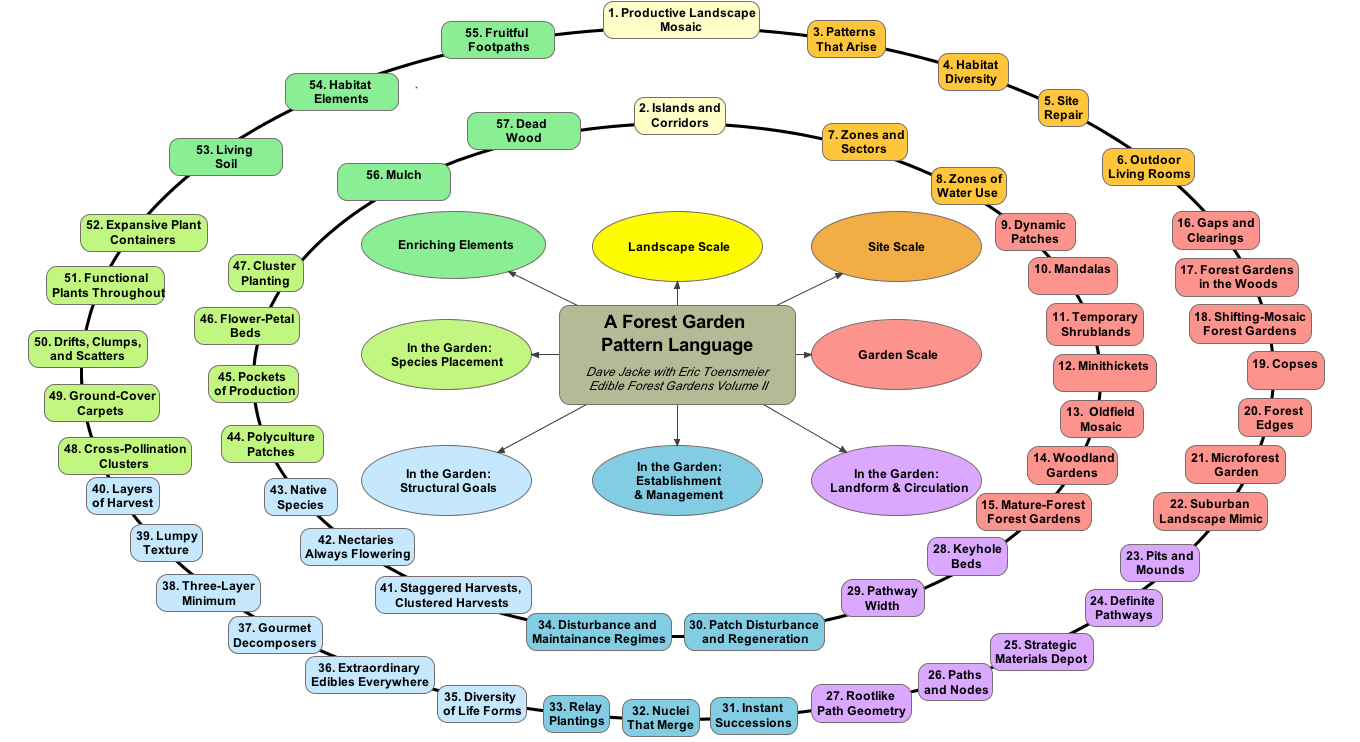
amazing pattern language for food foresting!
I have been conscious of the way beginning to think about a food forest leads one into complicated ideas, inspiration and adventure. But am stunned to find this:
... reported on the permaculture power blog, to which I have also added a link in the right column. Yes, I'm just a beginner. It is important to make a record as you begin, in my view. However naive. Geology provides some metaphorical language about learning: sometimes knowledge arrives with the explosive force of igneous rock, volcanoes and the like. More often it's a sedimentary process. History is best understood as a sedimentary process. I've long advised my children (to varying effect!) that to understand current history they need to begin the record learning the news on day one, whenever it is. So also with a blog, it can only get value as sedimentary layers are laid down. And fractured and folded and made more interesting over time, metamorphosing. The arrival of this volcano of ideas in that diagram certainly will metamorphose my mind as I get through it!
Subscribe to:
Posts (Atom)